vendredi 14 novembre 2008

Bocuse, quoiqu'ils en disent

De Bocuse

J’avais amèrement regretté, lors de mon passage précédent à Lyon, de n’avoir pas rendu ma visite rituelle à « Monsieur Paul ». C’est un drôle d’endroit, le restaurant Paul Bocuse, avec son chasseur issu d’un épisode de Tintin, la tronche au patron partout, les cocottes à vendre sur le chemin des toilettes, et surtout les recettes inchangées, absolument identiques depuis… depuis combien déjà ? Trente ans ? En tous cas, moi qui n’y vais que depuis une dizaine d’années, j’ai le sentiment de pouvoir vous réciter la carte de Paul Bocuse – même dans ses variations que je ne connais pas, puisque, pour célébrer le gibier, la maison propose d’audacieuses créations : le tout nouveau lièvre à la royale, l’inédit canard à l’orange, le chevreuil rôti…
De Bocuse

Mais ça, tout le monde le sait et tout le monde le dit. Ce qu’on ne dit pas, occupé qu’on est (enfin que certains sont) à dénoncer le « système Michelin », c’est que le restaurant de Paul Bocuse, pour démodé et kitch qu’il soit, est un des plus grands restaurants de France. Les maisons qui offrent la même régularité et la même perfection technique ne sont qu’un petit nombre. Ajoutez à cette compétence extrême à une cuisine personnelle et intense, même si elle a perdu l’éclat de la nouveauté, et une seule main vous suffira largement pour les énumérer.
De Bocuse

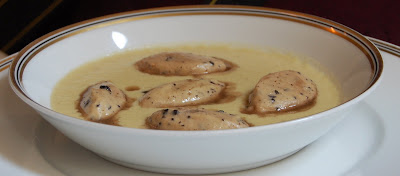
La pâte feuilletée chez Paul Bocuse est ainsi une des plus formidables qui soient, équilibre parfait entre légèreté et gourmandise, onctuosité et friabilité. Au niveau de Rabaey, de Conticini… Du coup, c’était pas dommage que, avec les copains bloggeurs, on en ait pris deux fois. La première fois, c’est le chapeau de la fameuse soupe aux truffes VGE (et ce nom même, la personne qu’il désigne, vous donnent toute la mesure de l’anachronisme de ce restaurant). Alors, c’était novembre d’une année à truffe médiocre, et franchement, malgré la générosité, appeler la soupe « aux truffes » ne la décrit pas bien. Mais c’est un bouillon de bœuf et de foie gras absolument parfait, clair, précis et intense au goût. J’ai souvent entendu que ce genre de plat étaient des plats de bistrot : qu’on me donne l’adresse ! Couvrir la soupe avec le feuilletage ne permet pas seulement de conserver tous ses arômes : ça mouille aussi le dessous de la pâte pendant que le dessus est bien doré. Miam. Par contre c’est très très chaud.
De Bocuse

(Photo Ptipois)
Pâte feuilleté encore pour le fameux loup en croûte, farcie avec une mousseline de langoustines et servi avec… une sauce Choron ! (Une sauce Choron, c’est une béarnaise tomatée – c’est un truc qu’on trouve dans Escoffier, un monument historique, quoi) La sauce, comme souvent dans la cuisine de Bocuse, et dans ce qu’on appelle la « grande tradition française », est le centre du plat, puissante et onctueuse, servie et resservie copieusement, difficile d’arrêter. Ce n’est pas de la cuisine qu’on mange à la petite cuillère ou avec des baguettes. Le bar est parfaitement cuit, la mousseline apporte une consiste de quenelle, très onctueuse mais ferme, et bien sût le feuilletage sur le dessus apporte non seulement du friable mais aussi de la matière.
De Bocuse

(Photo Ptipois aussi)
La sauce est aussi la star du plat suivant – la fameuse volaille de Bresse truffée en vessie. Là encore, la truffe est au service minimum, et la cuisson de la volaille est peut-être un peu trop à l’ancienne – c’est-à-dire un peu trop tout court. Mais la sauce suprême (une des sauces les plus bêtes dans l’Escoffier, vérifiez) est un plaisir dont on ne se lasse pas, et surtout la garniture de légume est phénoménalement délicieuse (je concède que l’intérêt du riz est plus mystérieux).
De Bocuse

Pendant ce temps, sur la même table, ceux qui n’aiment pas le poulet se font servir un canard sauvage, sauce à l’orange. J’aimais l’idée de la viande rôtie à la broche servie sur des sculptures de pain, je l’avais lue quelque part : mais cette fois, je l’ai vue. La vraie présentation à l’ancienne, feu d’artifice de nourritures apprêtées pour le bal, pantoufle de vair et citrouille à roulette. Les pommes soufflées, les girolles, la sauce à l’orange et les décorations de toutes sortes. Mais surtout, pour le peu que j’en ai goûté, l’usage du canard sauvage rend tout d’un coup justifiée, sensée la recette du canard à l’orange. J’ai lu ici et là en effet, surtout à propos de la Tour d’Argent, que la recette n’est après tout pas idéale, et c’est vrai qu’en général, l’orange écrase petit coin-coin, qui ne subsiste que par sa texture. C’est une tout autre histoire avec le vrai colvert de chasse : son mariage avec la sauce à l’orange est profondément harmonieux, améliorant les deux éléments de cette union heureuse.
De Bocuse

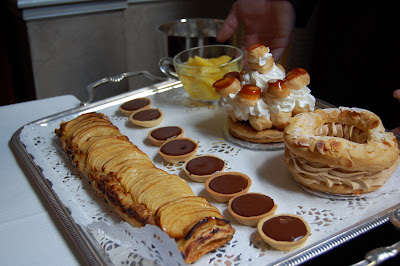
Il n’est pas utile de vous décrire tout le menu, mais un mot encore sur les desserts. Leur première caractéristique, que tous les amateurs apprécieront, est qu’il n’y a pas un chariot de dessert mais quatre. Au moment du service, vous êtes cernés : pas moyen de quitter la table. Tartes en tous genres, fruits au vin, fameux gâteau au chocolat « Président » (encore lui !) de Bernachon, glaces et sorbets, fruits… il faut choisir. En fait, il faut chercher en soi la ressource d’avaler encore quelque chose, car, invariablement, M. Paul rassasie les plus gros appétits.
De Bocuse

Mais au-delà de la Gargantuerie, ces desserts étaient extrêmement bons. Il se peut que, depuis ma dernière visite, M. Paul ait changé de pâtissier, car, dans mes souvenirs, l’opulence l’emportait sur l’excellence. Quoiqu’il en soit, le gâteau d’anniversaire était exemplairement chocolaté et équilibré, avec un genre de nougatine en dessous. La glace à la vanille était du plus haut niveau. Et la tarte « tatin », juste un pâte brisée, était profondément parfumée et onctueuse mais restait tout en douceur.
De Bocuse

Dans mon expérience, non seulement M. Paul n’est pas sur le déclin, mais il tendrait même à s’améliorer dans son genre, avec son armée de M.O.F. (cinq en activité, dont les diplômes sont fièrement accrochées dans l’entrée, au dessus de la baie vitrée de la cuisine, plus M. Paul, et on ne compte pas les anciens comme Roger Jaloux) et son restaurant improbable. Alors oui, il y a l’hommage à une cuisine historique. Mais il y a surtout un restaurant actuellement, effectivement unique et formidable, qui, si vous me demandez, mérite bien plus sa troisième étoile que bien des stars de Bourgogne ou de Paris.
De Bocuse

vendredi 31 octobre 2008

C'est Coluche qu'on assassine!

Peu importe si la mort de Coluche était ou pas un assassinat déguisé : de toute évidence, pour beaucoup, il ne suffit pas qu'il soit mort, il faudrait encore qu'il n'ait jamais existé. C'est ce à quoi s'emploie, volontairement ou non, Antoine de Caune dans son dernier film. Ce qu'il nous montre en effet, c'est une espèce de Bigard ancien, un bobo perdu dans son fric et sa libido, ayant fait fortune par accident, et se piquant, à l'occasion, en fin de banquet, de solidarité et de conscience sociale, mais pas trop. Petit Sarkozy des années Giscard, le Coluche de ce film est avant tout occupé de ses partouzes, de sa coke, de sa tune et de ses potes. De la liberté, de l'insolence, de la pertinence de la critique par Coluche, il ne reste rien. Rien. Juste la vulgarité, vaguement choquante, profondément vaine. 


Demaison, l'acteur qui joue Coluche, qui s'en joue plutôt, nous rejoue certes des classiques. Mais non seulement il le fait comme un pied, rigide, aussi pathétique que nous autres adolescents des années 1980 étions exactement dans le même exercice -- imiter Coluche --, mais encore il ne reprend du discours de Coluche que la boufonnerie innocente concentrée sur les pubs de lessive et les obscénités. Puisqu'on nous parle de la candidature de Coluche à l'élection présidentielle, on aurait pu nous parler de sa critique féroce et juste des politiques de l'époque. Mais tout ce qu'on nous en rend, c'est l'idée de penser à Lecanuet quand on s'entraîne au tir au pistolet.

Pour un peu, les vrais héros du film, ce seraient Attali et Mitterand, l'action politique en vraie, alors que les bouffons ne peuvent rien, ne veulent rien. Le film se conclut d'abord sur Coluche rejoignant Attali rue du Solférino le 10 mai 1981, revenant au bercail en somme, et gratifiant les caméras de télé d'une grimace. Et quelques mois plus tard, il passe devant un pauvre affamé qui fouille une poubelle dans le Parc Montsouris. Il s'arrête, regarde, passe son chemin. 

C'est donc en somme un film sur les "marrants" d'aujourd'hui, les de Caunes justement, les qui-vous-voulez qui ne font de mal, ou de bien, à personne, et qui ne parlent de rien. Et plutôt que de jouer les vieux cons, de nous laisser croire qu'il y a eu, à un moment, des comiques qui disaient des choses profondes et justes, qui dégagaient de la liberté et de l'esprit, il nous propose de rejeter ces illusion dangereuses, de les regarder comme des illusions perdues auxquelles nous restons sentimentalement attaché, bêtement, mais dont dans le fond nous nous portons mieux de nous être défaits. Triste renoncement.

mercredi 8 octobre 2008

L'Ambroisie, trop belle pour toi

L'Ambroisie on a late September Thursday night -- party of four. My overwhelming impression was that of an extremly civilised place, and even, quite frankly, of a place reserved to the happy few. Clearly, the restaurant is not even interested in making you the meal of your life. Not even a very special party. They're focused on an aristocratic model of almost daily "you can't afford it if you have to ask about the price" food model. The setting (which is starting to get old) reinforces an impression of old French nobility, pretending to be holders of century old secrets when, in fact, the secrets are those of Claude Peyrot from the 1980s. The spirit is pre-revolutionary, ancien régime -- you're in or you're out.

I arrived early and asked le Moullac what was off the menu that day - nothing, everything is in there, he said. But then the next table had lobster ravioli and wild duck pie, both off menus. It's funny, not ha-ha funny, that a scarred abandoned child has constructed something so clearly based on the historical heritage idea, a place that is in every regard mimicking some imaginary lordship and "medieval" tradition. It's also striking how the place that, ten years ago, was still a violent, schocking place (by the power of food) that produced life-changing taste experiences has turned into something so fundamentally smooth, refined, polished and self-assured. And while we're in the funny department, it is also the evolution that the Relais Bernard Loiseau followed. But Bernard Pacaud did not die. Or did he?

Maybe you'd like more detail about the actual food? It started with the usual gougères, temperature was nice, texture mastered, taste absent. Then, following the almost scene I made about our neighbors having lobster raviolis (or maybe just pretending to respond to my remarks when actually going as planned?), we succeeded in having some as amuses. The lobster cream was deliciously delicious, while the lobster itself was overcooked. All night, one of the co-diners, who liked it a lot, referred to it as "the mousse".

I got the chaud froid d'oeufs mollets, crème de céleri, caviar, one of the highlights though not the "wow" I expected. Two oeufs mollets, cold, are lying on a nice veal gelée (carefully reduced, no gelatine in there) that also embeds the Iranian caviar (probably not enough for both eggs). They pour a truly incredible celeriac cream on top of the dish, and, as you "go in", the yolk becomes a liant for the whole dish, particularly magical when you reach the caviar.

Another member of my party had some rougets with cèpes and a sauce of which she asked more -- but I did not taste it. I did taste the foie gras which was good not great and, most schockingly, wrapped in an old, stingy pepper -- more itchy than hot. No big deal, but it gave the feeling of eating food from a common charcuterie de village.

The four of us then had the famous seabass with caviar sauce and sliced artichoke. The caviar sauce, hardly sophisicated, is indeed perfect and intense. The seabass was as fresh as they say, but it was a tad overcooked to my taste, showing some of that paper feeling in the mouth. I told them and they told me they would know for next time that I like my fish at the lowest possible degree of cooking, just more evidence that l'Ambroisie is conceived for regulars.

The sweetbread "à la grenobloise" was better looking than it tasted. It was braisé, with the characteristic associated texture, and some fancy rings of melba toasts hanging on rosemary pikes, which were planted in the sweetbread. The charlotte de macaronis on the side actually steals the show. There's no question to me that the night before's sweetbread at Tante Louise, for one third of the price, was much better. And the Tante Louise sweetbread came with small girolles that were also better than the girolles served on the side of the pigeon at l'Ambroisie. That night, the l'Ambroisie girolles looked good too, like the sweetbread, but they were tasteless and not firm. Those girolles were the major letdown of the night. The pigeon was actually an excuse for garlic -- why not, but again, nothing to write home about.


Once again I had the best choice, which was lamb, extremly tender, and luckily so since it was basically rare. It came with some "nougatine" of garlic and almonds, unpractical to eat and not particularly useful for the dish. The only real wow of the night was the carrots on top of the artichoke on the side. There were three small slices, but they were moving and magical, slighly acidic, greatly flavourful, very crunchy and yet cooked (my guess is: cooked in white wine). And they came with plenty of absolutely excellent lamb juice to add on my plate. I mentioned recently, about Briffard, that only a handful of chefs do juices as well he does. Pacaud is one of them.

Cheeses were very good, though none was extraordinary. The famous chocolate tarts and vanilla ice cream did not disappoint for dessert, while the cheesecake was, I hate to say it, ordinary, and the peaches in the peach soup were not ripe enough. Le Moullac offered a Vouvray moelleux for apéritif that was thoroughly delicious. The "Winston Churchill" champagne was appropriate in these times of crisis, and a Puligny-Montrachet was chosen by Le Moullac to end the meal and it was everything you'd expect of such a wine.

After the meal I thought that I should reincorporate Ledoyen in my first tier restaurant list. Not because it suddently grew better, but because I can't argue anymore that l'Ambroisie is a better restaurant. And Ledoyen, expensive as it is, is less expensive than l'Ambroisie and offers the tasting menu with wine pairing at 284€. Not to mention that the menu with wine pairing at le Cinq is 210€, and I just find it better than both.

De L'Ambroisie

Now, don't get me wrong: this was an excellent night in an incredibly special setting, with service that grew even more friendly and adapting to our tastes as the night went on. The bill was still ca 1700€ for four, and at that price, as I said, they don't even try to make it the meal of your life and it is by any standard far from perfect, even though it is no doubt unique. But when money is no object, I understand why you would want to make this place your home. And I'm sure they'll do much better now that they know me better. If I give them a chance.


Thanks to our generous hosts.

mardi 16 septembre 2008

What's Nouvelle Cuisine?

The characterization of Nouvelle cuisine as light is misleading. If you think of Bocuse, Robuchon, Senderens, Guérard, even Loiseau, Winkler, or Passard. All rely heavily on butter and sometimes cream. One hardly leaves these places feeling light, eventhough there are degrees.

The main reason for butter is, that nothing replaces it to capture the flavors. Thanks to butter you can make mono-taste sauces that emphasize the complexity and richness of one ingredients: for instance a thyme or a tarragon butter sauce, served on the side of a fish cooked à l’unilatérale are very typical nouvelle cuisine dishes, still served by Winkler. Today, Passard’s Gratin d’oignon is an example of that mono-ingredient approach, which relies on butter to capture the flavours during the slow cooking and aims at demonstrating that a simple onion can be a grande cuisine dish, and not only some aromatic sidekick in a stock.

Winkler's seabass, cooked in salt,
with a tarragon and mustard sauce, parsley purée, potatoes


Technologies for capturing clear, pure tastes have been refined from the traditional to butter to more surprising infusions, mousses, etc. You could consider that the latest in pure nouvelle cuisine was reached in the early 90s, with Loiseau, Robuchon and Veyrat. And water.

The other day, Pti made a traditional nettle soup – I had no idea that it would have potatoes and leeks in there and cook for fourty minutes. To me, educated by Loiseau, a nettle soup was only water, salt and nettles, the nettles cooked à l’anglaise for a few minutes, stopped in ice, then blended with the water they cooked in. Same deal with the parsley sauce, for instance.
Loiseau's Jerusalemen artichoke soup
De Loiseau, 26 oct 2007

More than lightness, Nouvelle Cuisine can be characterized by a focus on ingredients and the clarity of their taste. By comparison, traditional cuisine, the Escoffier style, is more about transformation of ingredients, the magic of the act of cooking. Turning stuff that grows in or on the soil into delicious food. It's not that they did not use the best ingredients they have. Cooks always knew that you can't make good food without good ingredients. But in the traditional cuisine, cooking was about the transformation, the recipe, and how to create a taste. Stews, quenelles, are examples of long transformative processes creating pleasant and arguably artificial feelings in mouth. In nouvelle cuisine, it is about emphasising a taste more than about creating one. There is both a more natural and a more artistic approach in a way.

You can taste the pre-nouvelle cuisine approach in places like Michel Rostang or l’Auberge Bressane. A pasta or potato gratin are good example, or crêpes Suzettes. Another comparison I like to use is that the difference between Nouvelle and Ancienne Cuisine is reflected in the difference between Chinese and Vietnamese cuisine. Basically (no offence), in a Vietnamese Bo-Bun you can identify every ingredient clearly. In a Chinese Imperial style chicken, there is fusion of ingredients, and while it is delicious, it is actually hard to tell what exactly it is that you are eating.
Not nouvelle. Not bad, but not nouvelle.

There’s the same difference between nouvelle and ancienne cuisine. A classic of nouvelle cuisine, emphasized to the point of caricature, if you ask me, in Michel Bras’ Gargouillou, is the separate cooking of different vegetables. A Senderens approach to Ratatouille, a Loiseau ragout de legumes, as opposed to their traditional counterpart, all rely on separate cooking and last minute assembly.
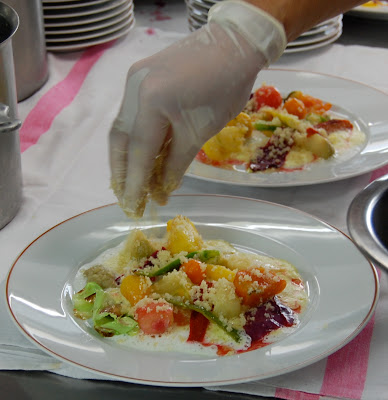
Passard's couscous de légumes

Of course there has been evolution and progress inside nouvelle cuisine. The first stage was, say, Bocuse, maybe Point, and their food does not taste that distinct to our palates anymore. But if you compare Bocuse to Rostang or to your (OK, my) grandmother’s cooking, you will feel the clarity of taste, the lightening of traditional recipes not in a dietetic but in an aesthetic sense. One dish which I think is a good example of the revolution the Nouvelle Cuisine was is that salade de rougets I had the other day at Gérard Besson. Suddenly, the plate is full of colors and distinct taste, while still being, formally, the traditional salad – a salad in which everything is mixed and soaked and hardly recognizable. As far as the plating is concerned, in Nouvelle Cuisine, it is a logical consequence of the search for control of the gustative experience and the separation and purity of flavors.
Besson's salade de rougets De Gérard Besson

By the way, what is the difference between Nouvelle Cuisine and California cuisine? I would argue, none, essentially. Except that they rely, like all good cuisines, on local and therefore different ingredients and traditions. Traditions reinterpreted, even reinvented: from Bocuse’s chicken to Loiseau’s frogs, Nouvelle Cuisine has been exactly that.

In the Robuchon school, there even some sort of conciliation between traditional and nouvelle cuisine: some ingredients are magnified with clear tastes, but melty, fusionned, regressive tastes are also present like in his pumpkin soup or his potato purée. This Robuchon synthesis is very apparent in the contrast of his two signature dishes: the aromatic herb salad and the potato purée. Both were served on the side of a perfect roast lamb, by the way.
So much work for this purée
De Table de JR, 14 mai 08

When opposing Nouvelle Cuisine to the restaurants that emerged in the 90s, many of them techno-molecular-something, I think that the operating word is cuisine. In French, it is what people do at home as well as the name of the room. It is how the people prepare food. Traditional and nouvelle cuisine are both cuisines – essentially, cooks do the same things we do at home and they do the same things we do. Only they’re professionals. And indeed, while places like Rostang or l’Auberge Bressane, or even Bocuse or Besson, use very similar techniques to what we use at home, the “advanced” nouvelle cuisine is extrelly work-intensive. Robuchon’s purée require hard work for sure, so does Bocuse’s gazpacho or pea soup made from small vegetables pealed one by one. Veyrat invented fat free fries but they take 40 minutes to do instead of 10. And I mentioned earlier using ten different pots to prepare a vegetable stew. You have to have staff and a professional kitchen.

By opposition, what you eat at Adria’s, Blumenthal’s, Amador’s, even at l’Astrance, is not cuisine in the sense that it has not much to do with feeding you, it is not an extension or a modification of how you would cook at home. It just has nothing to do with it. What emerged since Nouvelle Cuisine arguably peaked is not better food but a shift or return of emphasis on other dimensions of the fine dining experience than having the best possible food. Novelty and surprise are major factors, as is the show dimension. Adria offers, it seems, an unparalleled stimulation of the mind and a unique reconsideration of the nature of the culinary experience. Amador is both playful and generous.
Vinaigrette „en cocoon“
Inside the cloud is a ball of balsamic, while you inject the olive oil
in your mouth thank to the device on the right
De Amador (May 8th, 2008)

Come to think of it, what else could young chefs do to differentiate themselves? The champions of nouvelle cuisine had created a new orthodoxy and of course set their own bar for excellence. How would you make better, more intense and pure food than Robuchon or Pacaud or Senderens when they’re on? You can’t. They’ve just perfected their art the same way an Escoffier probably had before them. You just can’t beat them to their own game. But you can get tired of their game. Some people do.

vendredi 12 septembre 2008

Democrats, just say it! She rocks!

Regular readers know that I have been an Obama supporter for a long time, and obviously the change in the dynamics of this election since Sarah Palin was chosen by McCain had me worried. So I'd like to say it, and mostly to suggest democrats to say it too: Palin rocks!

The Republican ads, the discourse, even Karl Rove's op-ed in the Wall Street Journal pretending to give an advice to Obama to stop his attacks on Palin when Obama has not, in fact, attacked Palin: this all demonstrates that the fight about Palin is the fight the Republicans want to have. Why wouldn't they? She's good-looking, she's bold, she is indeniably different from anything we've seen on a presidential ticket before, and she is definitely a woman. And even the supposed skeletons in her closet are only likely to make her like more: So she was a pitbull with her former brother-in-law? Many think, and say that a pitbul is exactly what we need. So she believes in God and creation? That's better than being a godless liberal, many think. Plus, any questionable attack on a woman mechanically creates a defence reaction among some undecided women, and men, and with reasons. After all, claims that Palin is a monster are widely exaggerated. She's obviously not a liberal, but the thing that is the worst about her for us Obama supporters is that she's creating a strong movement in favour of John McCain.

Democrats can't win if the question is "do you like Wonder Woman?". Of course we like her. Who doesn't? God, I may well love her. I don't want her as President of course, but that's not based on her being a monster. They need to bring back the debate on "do you want more Bush?" (or even "what kind of change do you want?", etc) . So here's my proposition to Democrats and other Obama supporters: concede the point publicly. Governor Palin is an extraordinary woman and an exciting candidate. That fight can't be won, and obviously the Rove gang won't let it fade either. The Obama camp needs to clearly say that this fight is lost: Palin rocks! That way they will efficiently diffuse the Republican tactic of pretending that Palin is attacked. I'd like to see a McCain spokesperson saying "the claim from the Obama camp that Palin rocks is offensive and sexist and the only question in this election are about Palin's life and family".
And so here is, free of charge, a draft for an ad to run in all 50 states day and night: "The McCain campaign wants to make this election about Sarah Palin. It makes sense. She's an extraordinary woman and an uncommon candidate. But this election is not about Sarah Palin. It is about our country and our future. Do you really want more of the same policies?"

Come to think of it, the Republican VP president is not the traditional attack dog: instead, they invented the attacked dog, which is really new.

jeudi 4 septembre 2008

Le Tastevin, gloire de la grande bourgeoise française


Agrandir le plan

English version coming soon

Maisons-Laffitte, ce petit paradis presque inconnu, au bord des Yvelines... Il y a ici une belle maison bourgeoise, une vraie, comme on ne s'attend pas à en trouver à 15min de l'Etoile. Tous les jours, c'est comme un déjeuner du dimanche chez une vieille tante fortunée: sa belle demeure impeccable et cirée, avec un grand escalier tout vernis, des bibelots et des tapis, des lambris impeccables, un gentil labrador, un vieux chef qui connait la chanson, et aussi la profession.

Et puis comme vous le voyez, au premier rayon de soleils, il y a les tables non seulement sur la terrasse mais encore dans le jardin, séparées par des petits bosquets.

Mais ça n'est pas tout. Dans une attraction comme ça, on pourrait s'attendre à des prestations culinaires un peu relâchées, confites dans leur certitude et leur approximation. Au lieu de ça, on a une longue carte très classique et très bien réalisée et plein de suggestions du jour. Ce jour-là, il y avait raviolis de homard -- ça ne se refuse pas. La pâte est fine, parfaitement dosée entre ferme et fondant, le homard est ferme avec ses fibres bien serrées, et mes quatre beaux raviolis sont posés sur un beau lit d'épinard frais juste "tombés", un jus de crustacé joue plus les assaisonnements que les sauces.

Classique de la maison ensuite avec une belle pomme de ris de veau pommes/câpres flanquée d'une invraisemblable charlotte de macaronis aux girolles. Quand on commence à voir des structures faites en pâtes, on sait qu'on a changé de dimension. Même si, dans le fond, des macaronis juste cuits à la minute avec leur girolles auraient été meilleurs, le charme de cette présentation à la Escoffier est imparable.

On est d'autant plus emballé, ceci dit, que la cuisson du ris est vraiment parfaite (chapeau, ça n'est pas si courant même dans les grandes maisons), et que l'équilibre de la recette, sous ses allures balourdes (du ris, des pâtes et des champignons), est assurée par l'acidité des dés de pomme et des câpres.

Et puis le portrait ne serait pas complet sans un annuaire de cave qui a tout bon dans la grande tradition, vins jeunes et vieux, châteaux alignés comme à la parade, Raveneau et Trimbach, conseil compétent. N'attendez pas de vins exotiques, néanmoins, à moins que, dans l'esprit de la maison, le Languedoc ne soit pour vous la quintessence de l'hétérodoxie vinicole.

Bien sûr, c'est pas donné. Mon repas d'hier soir était à 151€ pp avec un millefeuille et une bouteille de Cassis blanc. Il y a un menu dégustation à 95€, et un menu du déjeuner en semaine ("menu d'affaires") à 45€. Mais le dépaysement, et le charme certes discret mais surtout éternel de la bourgeoisie, est à ce prix, du moins tant qu'on reste à portée de vue de la Tour Eiffel.

mercredi 30 juillet 2008

Paris in August -- good food nevertheless

Every foodie who is in Paris in August is likely to feel cheated. Because it is someone people ask me very often these days, here's a list of foodie places open in August. I'll enrich this list with my discoveries and memories all month. I'll also be hapy to add your suggestions.

Top restaurants
- L'Arpège (best restaurant in the world, most expensive too)
- Joël Robuchon (at La Table, don't miss the 55eur lunch deal, including beverage)
- La Grande Cascade (Frédéric Robert is an exceptionally rigorous cook, a true master -- to my taste he lacks the inspiration and genius of his former masters Senderens and Peyrot, but both owe a lot to his rigour nevertheless and the place itself is georgeous, in the Bois)
- Le Cinq for the first steps of Briffard this summer
- Le Bristol always (don't miss the poached poularde, the ris de veau)

More ordinary restaurants
Brasseries/bistrots
- La Rotonde (the textbook, very good brasserie at the corner of Bd Raspail and Bd du Montparnasse -- everything is great, everyday and all day long until midnight)
- Le Petit Riche (for its specialities like the rillons and the veal chop and the setting -- also serves late night)
- Astier (a textbook bistrot, cheap and open 365 days a year, with good cheese and great wines)
- Meating (for expensive meat in the 17th)
- La Fontaine de Mars, Chez les Anges in the 7th
- The historic bistrot brasserie Joséphine Chez Dumonnet is listed open by some and closed by others. I'll check.

Asian
- In Chinatown: Solya, Sinorama, Asia Palace, Pho 14
- Japanese: Kinugawa (rue du Mont Thabor), Benkay (by the Seine in the 15th), both luxurious
- Fancy Chinese: Tsé Yang, Tong Yen, Passy Mandarin
- Co Tu, rue de la Croix-Nivert

Italian
- Fontanarosa, bd Garibaldi

Bakeries
- Pichard, rue Cambronne
- BE in the Printemps (bd Haussmann)
- Le boulanger de Monge

Pastry shop
- Constant, Dalloyau, Hediard are open all summer. Don't miss Constant's icecreams, Dalloyau chocolate macaron (chocolate only), pastry at Hédiard (eventhough they're not made on site). The bakeries I mentioned have good pastry as well.

Butchers
- Boucheries Nivernaises rue du faubourg Saint Honoré (especially for their well aged Simmenthal beef)
- Lesourd rue Lecourbe (don't miss his summer deals on sweetbreads)
- A Corsican shop on rue des martyrs whose name I can't remember

General food shopping
- Most markets become desert in August. Lafayette Gourmet (Galeries Lafayette, bd Haussmann, 8th) is a good alternative to la grande Epicerie (rue de Sèvres, 6th)
- Nevertheless, the market on av du Pdt Wilson has Thiébault (the extraordinay lovall grown vegetables that most top restaurants use) all August -- on wednesdays and saturdays morning.
- Quatrehomme and Cantin do not close (cheese)

vendredi 4 juillet 2008

Your food guide to France

Hire me to organise your foodie experience in France!

Let me help you enjoy the best of food in France. Let's visit markets and cook together, let's find out what are the restaurants and shops you will most enjoy, tailored to your taste and expectations. Visit wineries and discover local ingredients and classic cooking techniques.

Just leave a comment here with your email -- it won't be published and we'll get in touch and see together how I can help you foodie making the best of your sojourn in France.

mardi 20 mai 2008

Gérard Besson: la tradition, ça a du bon


The English version is here.

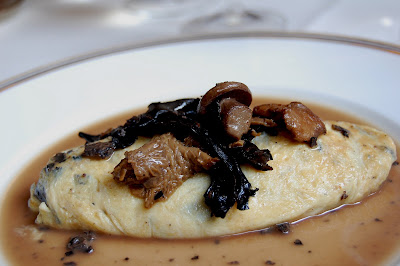
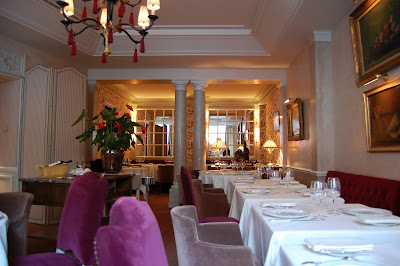
Il y a encore à Paris un restaurant étoilé où on peut manger des quenelles truffées dans une soupe d'asperges, où le chef fait une omelette, et où il y a un chariot de desserts avec Saint-Honoré ET Paris-Brest. Gérard Besson est un chef classique impeccable, un MOF au classicisme unique -- je ne lui connais pas de concurrent à Paris.

Le menu du déjeuner est une belle affaire. Cette saison, Gérard Besson avait les seules bonnes truffes que j'ai rencontrées. Besson est un initié de la truffe: il sait où les trouver, comment les négocier, comment les choisir. Oh, et il sait aussi les cuire, et qu'il y a différentes façon de le faire, ainsi que le suggère la page entière de son menu dédié au diamant noir. C'est de la truffe qui embaume la pièce. Certains soirs d'hiver quand le restaurant est plein de clients et de truffes, il paraît que certaines femmes s'en trouvent mal.

C'est une cuisine à l'ancienne, mais pas celle de Rostang ou d'Escoffier. C'est avec Bocuse que la parenté est la plus apparente, ancrée dans les recettes et les alliances classiques, mais simplifiées, épurées. Ptipois, à qui je vole sans vergogne la moitié de mes idées (et l'autre moitié de ma femme), avait un pigeon qui, aux standard modernes, était surcuit. Mais, dans cette recette avec le foie gras, il n'aurait pas pu être meilleur s'il avait été rosé, comme on l'aime et l'attend de nos jours.

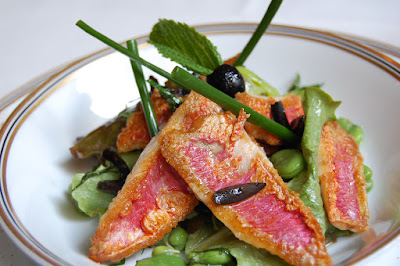
Ce plat de rouget était une célébration du printemps, févettes, menthe, salade et olive. C'est d'abord un des plats les plus simplement beaux qu'on m'ait jamais servis, et j'espère que la photo vous en donne une vague idée. Je ne pouvais m'empêcher de penser au choc que ce genre de recette a dû être au temps des frère Troisgros et de Bocuse, quand on réinventait la cuisine traditionelle tout en la respectant scrupuleusement, mettant les ingrédients au premier plan comme jamais.

C'est un vrai endroit de gourmands. Il ne faut pas venir ici pour l'innovation. Mais si vous aimez la truffe et le gibier, si vous croyez que les grands classiques, basés sur les ingrédients de saison, une exécution parfaite et, oui, un peu de tradition, ont encore de l'avenir; alors Gérard Besson est pour vous. A la table d'à côté, un célèbre grand gourmand, beurré comme un petit Lu, avait l'air d'apprécier autant que nous les petites cailles que le chef avait fait venir spécialement de la Dombe pour sa tablée de jouisseurs contents. L'odeur de ces cailles... j'aurais voulu faire partie de leur société pas si secrète.

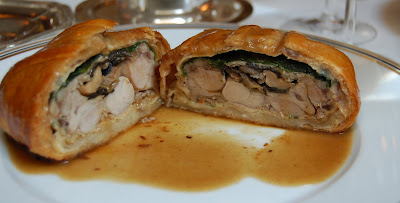
J'oubliais de vous parler du lapin en feuilletage. J'aurais dû...

mercredi 14 mai 2008

Paris, Robuchon: Table or Atelier?


When in Paris, there are two ways of tasting Robuchon branded-food: one is the most famous Atelier, which I reviewed a few months ago. The other is the more discreet and conventional La Table, in the 16th. It is more conventional because, as the name suggests, there are tables. And you can get a reservation. And there is service. Some pretty excellent service, actually. I think what impressed me most is when they brought an extra pair of spoons, having noticed that we were tasting each other's courses. Oh, and also, they don't rush you out by sending you everything you have ordered at the same time.

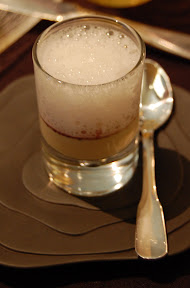
Another significant appeal of La Table is the best of all Robuchon traditions: a very affordable lunch menu, including wine, water and coffee (and service of course) at 55 euro. Because I would do anything for you, I volunteered to try. It started with a very well done amuse of foie gras mousse, porto reduction, and parmesan mousse. It's testament to their style: great ingredients first, simple but subtle preparations -- back to basics.

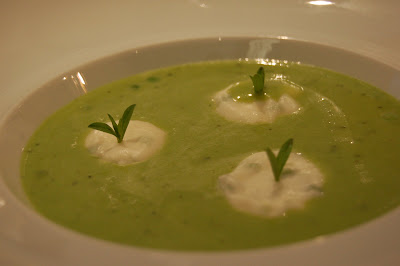
Then there was a soup of green peas with three goat cheese raviolis inside. The dough of the ravioli was so thin that it was barely noticeable, so the course was really pea and cheese. It's an interesting pairing, underlining the light acidity of the cheese, playing on a contrast of temperature as well. But it is mostly interesting because of the perfect soup, a "velouté" they call it, and velouté it is, incredibly onctuous. Indeed they do it as should be, meaning that they actually peel the peas one by one. And they blend it over and over again. And they have some very nice crème fraîche, that can't hurt. In any case, it is a demonstration that was is precious about haute cuisine is the skill and the labour more than the ingredients themselves. In general, this menu is a brilliant demonstration that top cuisine doesn't need expensive ingredients. So much so that, quite frankly, I'm not sure I even want to try their "regular" fine dining, lobster and veal chop and all.

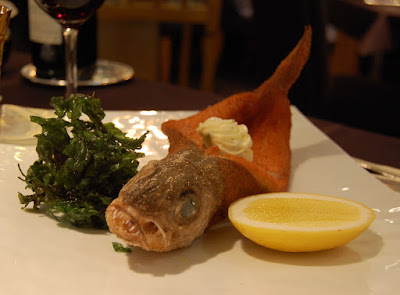
Then came an absolut Robuchon classic, the Merlan frit Colbert. It's just that great and simple -- hardly different from l'Atelier, though maybe even lighter. The fish flesh is melty and almost immaterial, the very thin crumb only protect the flesh, seasons it and, of course, crisps. Fried parsley is on the side is not lighter than air but lighter than thin paper. And the infamous Robuchon purée came on the side, as with each Robuchon course these days. There again, it felt less ridiculously buttery than at l'Atelier, where, as I wrote, it is more a sauce than a side.
My codiner, I should mention, has a codfish course that was very perfect as well, and that felt so healty that I suspect that eating it can replace fitness.

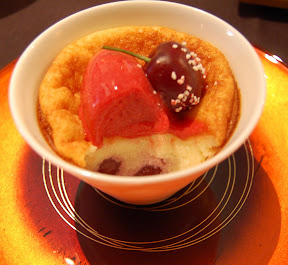
Dessert was a textbook clafoutis, not unlike the one at Jamin back in the days. One often associate clafoutis memories with guilty child memories, a rich sweet. But the Robuchon version is not too sweet, not heavy, just onctuous. Of course the cherries have their stones in, which is also part of the pleasure. Just yum.

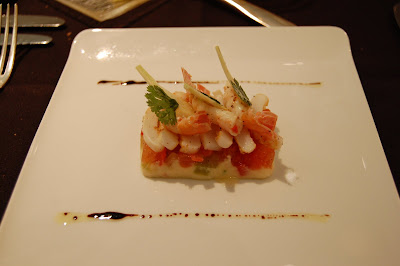
Okay, okay, I confess: I added some extras that are a big charm of the Robuchon places, where you can order tasting portions of great recipes. There was a funny artichoke/langoustine dish, with cute little langoustines that made the same irresistible impression as baby vegetables, if you know what I mean. On an artichoke mousse, there were tomato and sweet pepper dices, squid and the langoustines. There again, very fresh, very healthy, though I am not entirely sure that it is the best way to put this seafood forward. It's more like a sophisticated version of shrimp cocktail.

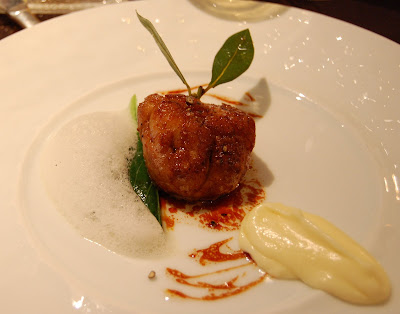
And there was also the sweetbread -- because the one at l'Atelier is the best in town, I would not go to a Robuchon place without having some. The recipe, on laurel and with Romaine, is the same at both places. But the one at la Table is more brown and caramelised, while the one at l'Atelier is almost white and so melty that it is almost creamy. It is nevertheless thoroughly enjoyable.

So: l'Atelier, or la Table? Well, La table's cooking is lighter, gentler and more consistent. But l'Atelier, quite frankly, still has some wows like their sweetbread. Both are excellent choices, but in different circumstances: La Table is, as you would have guessed, for a real meal. L'Atelier, really, is good for high end snacking before or after theatre or concert (plus, those are the only times where you might get a seat). L'Atelier really does not do the work of offering fine dining experience, but only some teasers to the food component of it. But all in all, la Table is a place where I plan to go regularly, especially for lunch.

dimanche 4 mai 2008

Bau, I don't know why


Great chefs make great meals. There are plenty of criteria which critics and food writers would like to use, ingredients, technique, style... but in the end it just comes down to this simple truth.

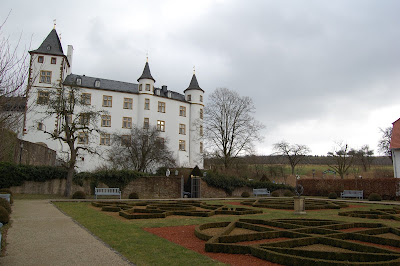
This 11th century castle is located close to the French and Luxembourg borders. It is also very close to an ugly modern casino – so close it actually touches it.

The young Christian Bau was born in the Black Forest, where he finished his training in the n°1 German restaurant, the Schwarzwaldstube of Harald Wohlfahrt. Like in any great and early success, his story is a combination of talent and luck – the owner of the Casino was looking to build a high end hotel-restaurant in the castle, Bau was a souschef at Wohlfahrt but his best friend was in the neighbourhood and teh Baus were visiting for the holidays. Long story short, the restaurant is built for them, and they end up with the third Michelin star in 2007.

I’d like to tell you that the restaurant has life-changing ingredients. Or it using never heard before techniques. Or that its style is redefining what a restaurant is. Ingredients were very good, techniques well mastered of course. Not all third Michelin stars come without reason. Yet all I can tell you is my meal at Christian Bau was wonderful.

It was a long tasting menu, but superiorly balanced. I’m a big skeptic about big tasting menus in general. Most of the time it is way too much food, and it is a roller coaster. There are plenty of little bites, some are good and you’re frustrated you can’t have more. All the more so since some are unpleasant and you’re sorry you had to use stomach space for them. In the end, they’re often exactly what they say they are: tasting samples so that next time you know what you like and you can have a good meal. Hopefully.

Bau’s meal was a perfect party. Every course was very good, some excellent, and it always felt like you had exactly enough. I did not feel frustrated at not having more, neither did I feel to full to enjoy the end of the meal.

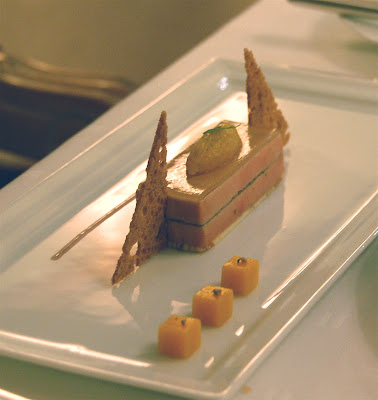
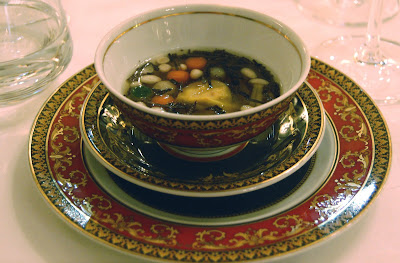
Two things in particular made the meal party-like. First, as you can judge from the pictures, there’s a kind of stylistic melting-pot involved – you can see it in courses as well as in china and plating. For the foie gras course for example, there was a soup served in Chinese-like china, a minimalistic foie gras sorbet, and a very 1990s cake of foie gras and mango. One course looked like l’Astrance, one like Gagnaire, one like Wohlfahrt. There was generosity and there was minimalistic precision, as well as wild inspiration here and there.

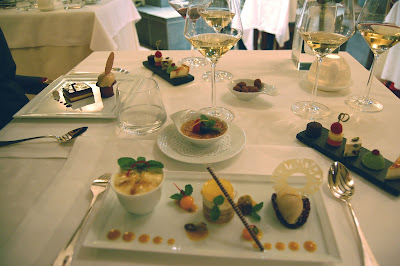
Then dishes just looked georgous and party-like. See that dessert table, with one all-vanilla dessert on the front and a chocolate-passion fruit one on the side. It’s like some sort of culinary confetti. Before I actually went to Rochat, alas, I was imagining that his food would taste like Bau’s, because it looked so good. Both look like infinite skill and precision are used to make the dish look good while clearly expressing the ingredient as what they are. No square sweetbread or Euclidian plating here, but also not ingredients prosaically laid in the plate.

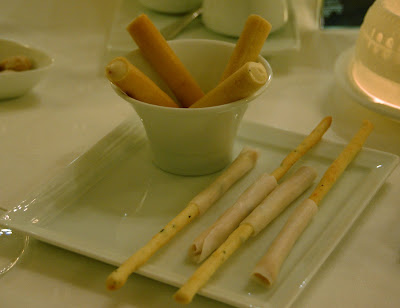
The meal had several highlights, but let me mention some: I particularly loved the simplicity of the pre-amuses of gressini just wrapped in high quality lardo. The idea is rustic and simple simplicity. But the execution shows great precision, a perfect match of the grissini and the lardo, balance of saltiness and texture in particular. The lardo was sliced recently so it does not sweat, and the grissini is not wet from the lardo.

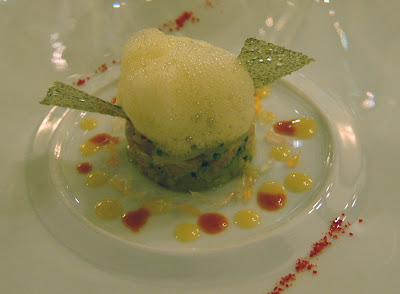
A starter of crab, scallop and citrus looked bland but was very artful taste wise. When you first bit it, the citrus and the seaweed are overwhelming and you thing that crab and scallops will only play texture, that their taste will be hidden. But after the first strike of citrus, the iodine and sweetness of the crab and scallop actually kicked in, like the sea would retire and reveal the seafood. The rice vinegar played an interesting transition between the first and second phase.

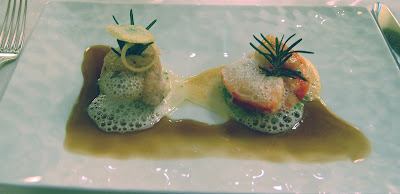
One very simple main, but very efficient, was the sweetbread and gambas. Both are rosemary roasted on rosemary sticks, both under a rosemary foam, both with a juice of veal breast (that’s right, not your common veal juice – this one has a richer texture and a sweeter taste). This is a puzzling dish, because it is so simple and it works. The seafood is the one with the intense taste, while the sweetbread brings meltiness. They don’t work so well if you mix them in one bite, but if you separate the bites, there is a “long distance relationship” going on with the two main ingredients – same preparation of different ingredients with different effects.

The preparation of the big sole was very exciting too, and I also don’t really know why. The sole was cooked at low-temperature, had a Parmesan crust, and was lying on artichokes and on parmesan raviolis. The sauce was very liquid, based on Bellota and olive oil – and was slightly reminded by a tiny roll of Bellota on top of the fish. As you can see, this was a big nice sole, which sure helps. On the whole there the fish and its sides were great matches for one another.

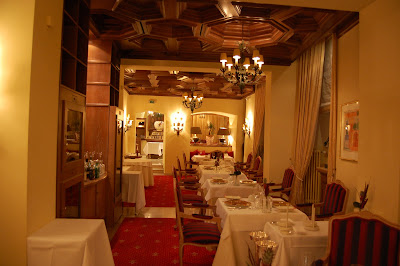
I should also mention that his a very tiny dining room, ten tables top, whose architecture reminds of the age of the castle. A young and pretty woman is in charge of wine pleasures, and as you would expect from the location, they are specialists of these wonderful Mosel valley Rieslings, which are also so easy to pair.

All in all, I just can’t tell you what’s so great with Bau. You’ll have to go. Looking at the pictures, you may share my point that it's hard to see why this would a restaurant worth a trip. Yet it is. The good occasion is a special, celebratory meal, because that is how this cooking is intended.