
Great chefs make great meals. There are plenty of criteria which critics and food writers would like to use, ingredients, technique, style... but in the end it just comes down to this simple truth.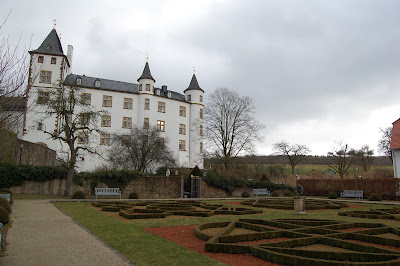
This 11th century castle is located close to the French and Luxembourg borders. It is also very close to an ugly modern casino – so close it actually touches it.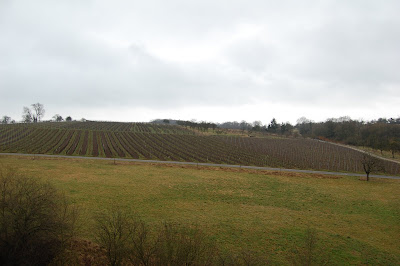
The young Christian Bau was born in the Black Forest, where he finished his training in the n°1 German restaurant, the Schwarzwaldstube of Harald Wohlfahrt. Like in any great and early success, his story is a combination of talent and luck – the owner of the Casino was looking to build a high end hotel-restaurant in the castle, Bau was a souschef at Wohlfahrt but his best friend was in the neighbourhood and teh Baus were visiting for the holidays. Long story short, the restaurant is built for them, and they end up with the third Michelin star in 2007.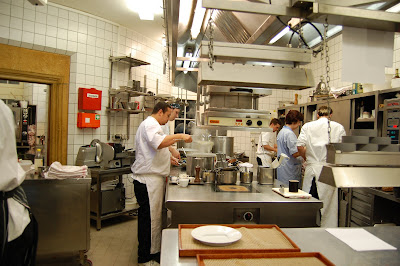
I’d like to tell you that the restaurant has life-changing ingredients. Or it using never heard before techniques. Or that its style is redefining what a restaurant is. Ingredients were very good, techniques well mastered of course. Not all third Michelin stars come without reason. Yet all I can tell you is my meal at Christian Bau was wonderful.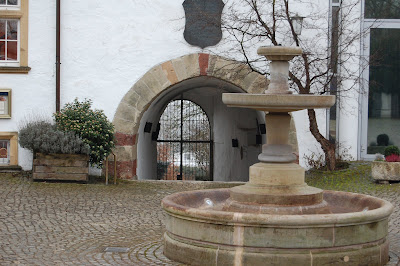
It was a long tasting menu, but superiorly balanced. I’m a big skeptic about big tasting menus in general. Most of the time it is way too much food, and it is a roller coaster. There are plenty of little bites, some are good and you’re frustrated you can’t have more. All the more so since some are unpleasant and you’re sorry you had to use stomach space for them. In the end, they’re often exactly what they say they are: tasting samples so that next time you know what you like and you can have a good meal. Hopefully.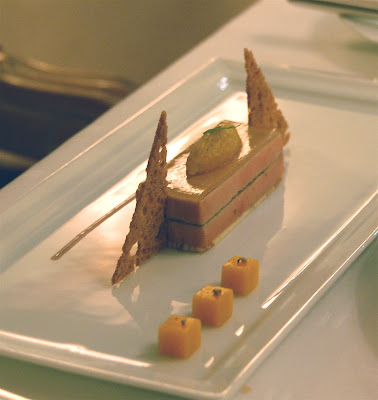
Bau’s meal was a perfect party. Every course was very good, some excellent, and it always felt like you had exactly enough. I did not feel frustrated at not having more, neither did I feel to full to enjoy the end of the meal.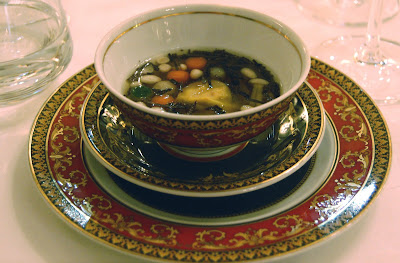
Two things in particular made the meal party-like. First, as you can judge from the pictures, there’s a kind of stylistic melting-pot involved – you can see it in courses as well as in china and plating. For the foie gras course for example, there was a soup served in Chinese-like china, a minimalistic foie gras sorbet, and a very 1990s cake of foie gras and mango. One course looked like l’Astrance, one like Gagnaire, one like Wohlfahrt. There was generosity and there was minimalistic precision, as well as wild inspiration here and there.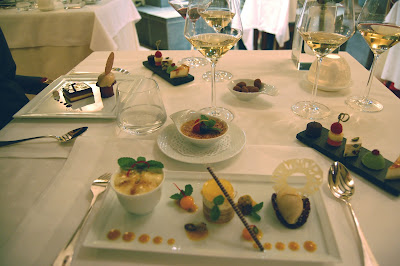
Then dishes just looked georgous and party-like. See that dessert table, with one all-vanilla dessert on the front and a chocolate-passion fruit one on the side. It’s like some sort of culinary confetti. Before I actually went to Rochat, alas, I was imagining that his food would taste like Bau’s, because it looked so good. Both look like infinite skill and precision are used to make the dish look good while clearly expressing the ingredient as what they are. No square sweetbread or Euclidian plating here, but also not ingredients prosaically laid in the plate.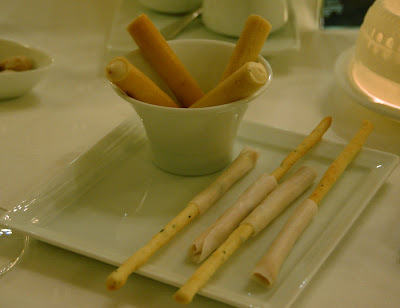
The meal had several highlights, but let me mention some: I particularly loved the simplicity of the pre-amuses of gressini just wrapped in high quality lardo. The idea is rustic and simple simplicity. But the execution shows great precision, a perfect match of the grissini and the lardo, balance of saltiness and texture in particular. The lardo was sliced recently so it does not sweat, and the grissini is not wet from the lardo.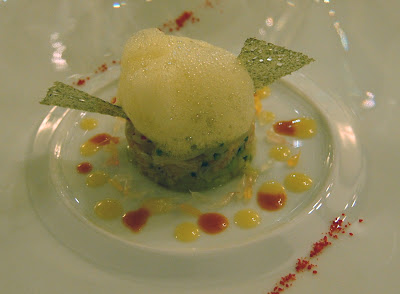
A starter of crab, scallop and citrus looked bland but was very artful taste wise. When you first bit it, the citrus and the seaweed are overwhelming and you thing that crab and scallops will only play texture, that their taste will be hidden. But after the first strike of citrus, the iodine and sweetness of the crab and scallop actually kicked in, like the sea would retire and reveal the seafood. The rice vinegar played an interesting transition between the first and second phase.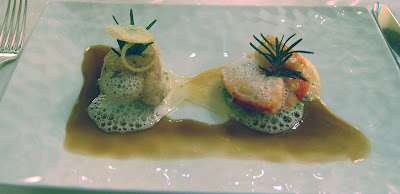
One very simple main, but very efficient, was the sweetbread and gambas. Both are rosemary roasted on rosemary sticks, both under a rosemary foam, both with a juice of veal breast (that’s right, not your common veal juice – this one has a richer texture and a sweeter taste). This is a puzzling dish, because it is so simple and it works. The seafood is the one with the intense taste, while the sweetbread brings meltiness. They don’t work so well if you mix them in one bite, but if you separate the bites, there is a “long distance relationship” going on with the two main ingredients – same preparation of different ingredients with different effects.
The preparation of the big sole was very exciting too, and I also don’t really know why. The sole was cooked at low-temperature, had a Parmesan crust, and was lying on artichokes and on parmesan raviolis. The sauce was very liquid, based on Bellota and olive oil – and was slightly reminded by a tiny roll of Bellota on top of the fish. As you can see, this was a big nice sole, which sure helps. On the whole there the fish and its sides were great matches for one another.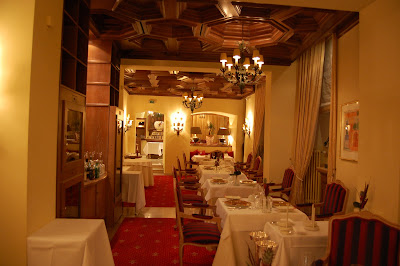
I should also mention that his a very tiny dining room, ten tables top, whose architecture reminds of the age of the castle. A young and pretty woman is in charge of wine pleasures, and as you would expect from the location, they are specialists of these wonderful Mosel valley Rieslings, which are also so easy to pair.
All in all, I just can’t tell you what’s so great with Bau. You’ll have to go. Looking at the pictures, you may share my point that it's hard to see why this would a restaurant worth a trip. Yet it is. The good occasion is a special, celebratory meal, because that is how this cooking is intended.
dimanche 4 mai 2008
Bau, I don't know why

jeudi 17 avril 2008
Gérard Besson: some things in France never die
La version française est ici.
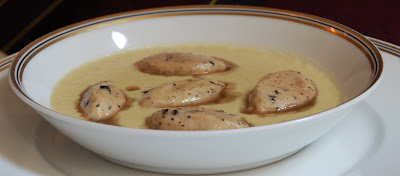
There is a starred restaurant in Paris where you can still have quenelles in a white asparagus soup, where the chef cooks omelettes where the dessert tray still offers of Paris Brest AND Saint Honoré. Gérard Besson is an impeccably classic chef. A uniquely classic one, as I cannot think of any example of a comparable restaurant in Paris nowadays.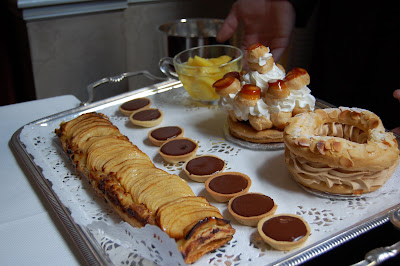
There is a really nice bargain for lunch. This season, there were also the only good truffles I had. The chef is obviously a truffle insider : he knows how to get them, choose them, negotiate them. Oh, and he also knows how to cook them, and that there are different many different, as his remarkable whole page of truffle specialties demonstrate. This is truffle that flavours the whole room – I was even told that some allergic woman just could not stay in the restaurant room one winter night.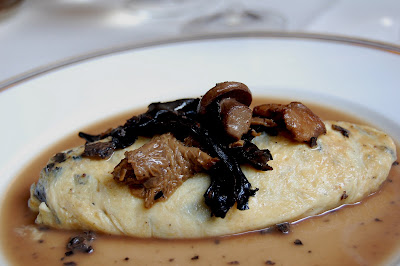
It’s an old style of cooking, but it is not Rostang (or Escoffier) : it is actually clearly related to the Bocuse style, rooted in classic recipes and alliances, only with simplified recipes and clearer taste. Ptipois, from whom I unapologetically stole the title of this post, had thus a pigeon with foie gras that was overcooked by modern standards. But, in this recipe, it could not have been better, and a rosé pigeon would not just have been as good, strangely.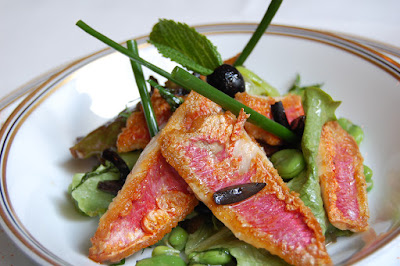
The red mullet dish was a celebration of spring, with its fava beans, mint, salad and olive. It is one of the most simply superb-looking dishes I ever had, as I hope that my picture partly reflects. I couldn’t help but thinking of the choc that this kind of recipe must have been in the early Bocuse or Troisgros days, when they were reinventing the traditional cuisine yet continuing it, and putting ingredients forward like never before.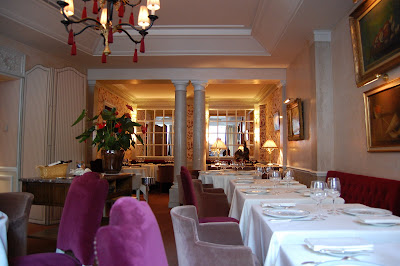
This is a real foodie place. Of course you shouldn’t come if you’re looking for innovation. But if you like truffle or game, if you believe that the real classics, based on seasonal ingredients, flawless execution and yes, some tradition, never die, then you should enjoy Gérard Besson. We did and the table next to us, including a very famous and very drunk food writer did too, very explicitly. They had some specially ordered Dombes quail whose scent made me regret that I was not a part of their not-so-secret society.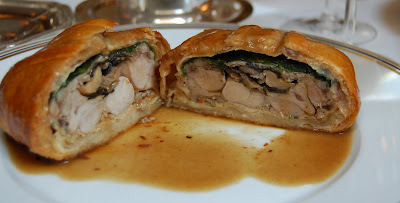
Oh and I forgot to mention that rabbit in a blanket. I should have.
mercredi 26 mars 2008
Les Ambassadeurs: hard working dilettante

Photos John Mariani
At the end of our dinner at les Ambassadeurs, we were alone in the room, and the remaining young staff offered us to take the coffee « in the lounge » in a way that made it a bit too obvious that they were anxious to have the room to themselves. As we complied with their unspoken request and were seating in that palace lobby, I could see through the glass doors those kids playing and throwing table cloths at each other. And in a way that strucks me as exemplar of exactly how fake, how cynical and desperate that place is. At no point during that whole, rather pleasant evening, did I have any feeling that anyone was actually genuinely trying to create a special moment for me.
It’s like it was all just a game. There seems to be a common belief of le Fooding and other Ratatouilles that fine dining is a ridiculous enterprise, impossible to take seriously, that in the end the only great food belongs to bistrots. It was like this belief had been fully integrated by Jean-François Piège and its staff, running the infinitely impressive restaurant of one of the most impressive palaces in the World.
So the only resource they have left is to be at the same time ironic and cynical about their business. So most Piège dishes are based on something else than making a good dish, a good meal, something pleasant. Here first courses pretend to be like a “TV platter”. There desserts are inspired from pictures in old books, when pastry was a subdiscipline of architecture. Somewhere else, spaghetti carbonara are on the menu – such a transgression!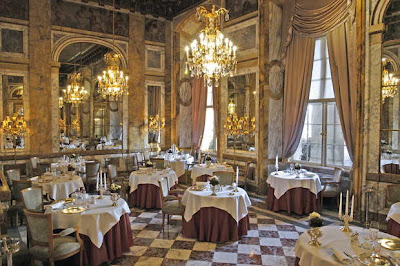
Of course there’s nothing wrong with these ideas in themselves, and I am the last person to think that a good restaurant needs to be sad and pretentious. Thierry Marx did something really interesting when deconstructing the spaghetti carbonara. Loiseau used to serve stuffed cabbage. But I think it should be good, offer a valuable experience, not a post-modern parody of one.
Take this infamous “blanc manger d’oeuf à la truffe”. On the website of the Crillon, you can actually see Jean-François Piège prepare the dish. It shows an incredible technical mastering. The white are whipped at the exact right consistency, put in a cylinder, the yok is somehow inserted inside so it just floats in the middle. This is cooked with nano-precision, and a rosace of truffle, as you can see, is added on top, and a truffle sauce around it. Of course when you start the dish, you go into the white with your spoon like into thin air, but then you reach the yok and it somehow is just warm and runny. How do you that, O master Piège? Will I, young Padawan, pathetic Karate kid, ever reach that level of sophistication and skills?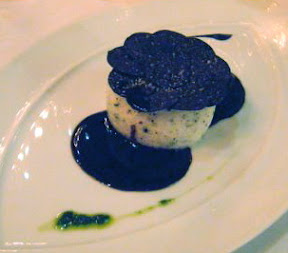
Photos Steve Plotnicki
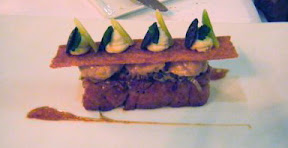
Of course nothing is bad here. One of the best things to my taste was the sweetbread “white and brown”, a very sophisticated construction, which is quite tasty, though by no mean otherwordly. The cooking is precise, though not perfect. And the presentation forces you to be creative – and careful – when eating it. A lobster dish was maybe one of the best things of the evening, inside a crispy cylinder, with a great lobster bisque on the side. It’s like a reminder that they could do great things if they wanted to.

But, you know, they’re over it, beyond that. They have menu holders and plants actually in pots, alive, for herbal teas at the end of the evening. So who needs actual top ingredients as long as they are fancy enough? Truffles were very tasteless, culminating in that double truffle salad dish. Cheeses, though from Master Anthony, were not great.
It’s too bad because they have incredible assets: this room is by far the classiest in town; it feels incredibly good. It is not as pretentious, pseudo-royal as le Meurice or Le Cinq, but it is genuinely, you know, grandiose. The wine list is full of classic wonders at reasonable prices (for a palace, that is). Dinner prices are as high as anywhere else, but the lunch menu features the same absolutely luxurious courses for an incredible bargain. If you’re interested in virtuosity for the sake of it and genuine fanciness, that is.

Desserts, plenty, not bad
It was nevertheless a very pleasant evening that we shared with the great Steve Plotnicki and his friends. He was kind enough to let me use his pictures of the dishes we had. I praise his name... and thank him.
dimanche 23 mars 2008
Exquisite and nostalgic Ledoyen
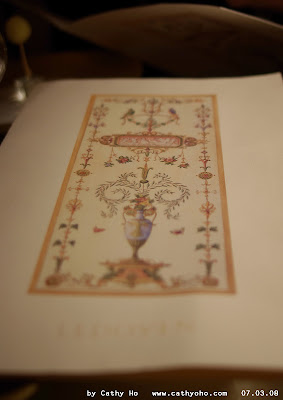
So Vedat Milor loves Ledoyen. In Gastroville, he puts is in the same league as l'Ambroisie. And I value Vedat's opinion. And I had never been to Ledoyen, mind you. So we went together for a wonderful evening. One evidence of how wonderful the evening is our surprise when we went out, that it was 2 a.m. already, and not before midnight as we had imagined. Staying home with the kids, my mother also was surprised by the late hour. So: sorry Maman, and thank you Vedat. Special thanks also to Cathy Ho, who happened to be dining at Ledoyen that night too and was kind enough to let me use the pictures that you see in that post. 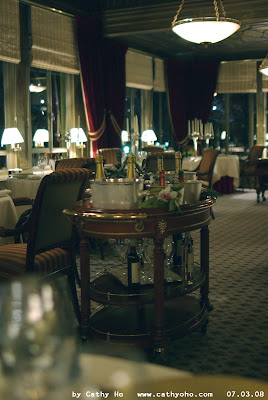
Those pictures will no doubt show you how refined and exquisite that place is. It is like the ultimate romantic, Parisian dinner spot, with its location in the park of the Champs Elysées, both in the middle of the city and country-like. The place started 1791 and, while it is perfectly decent, you sure can feel the history. In the daytime, how used the place is may even show too much. But in the evening, it is like a dream, and sure would expect Rita Hayworth and Orson Welles to come in any time. It makes it all the more surprising and, frankly, odd, that there are so many business tables.
That ultimate refinement is also very apparent in both the amuse and the mignardises. If you take a close look, you will see that, like in some sort of symphony, they actually have a formal similarity. Both are four different bites, the first one like a lollipop, the fourth one on some sort of triangle. Taste wise, the amuses are particularly impressive. As Cathy noticed, they resort to molecular cuisine techniques, like this liquid mozzarella ball, or the lollipop which actually hides a delicious, juicy redmullet. But those techniques, as should always be the case with great chefs, are only used to improve the food experience, and, in that case, highlight the ingredient.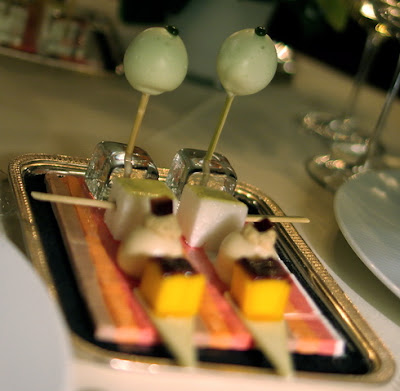
Indeed Ledoyen has top notch ingredients, on par only with l'Ambroisie or Le relais Bernard Loiseau. This was exemplified by what I considered the highlight of a very good meal, the mise en bouche of first (in the season) green vegetables. This was actually exemplary, intense, an experience that opens horizons. Those peas in particular, so incredibly fresh, so crunchy, so full of spring flavours, demonstrate what truly exceptional ingredients cooked with infinite precision and care can be. "Premier matin du monde", they could call it.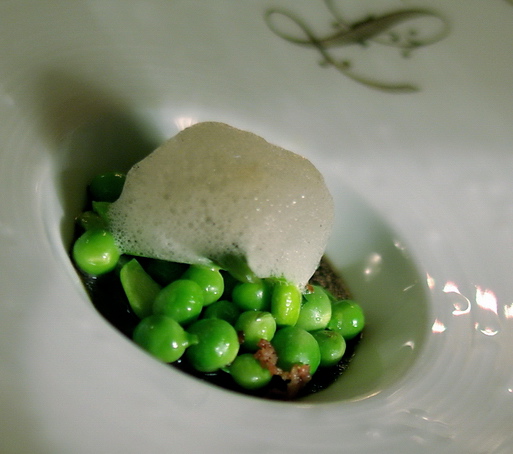
Another schockingly good ingredient (among other) was to be found in that infamous langoustine course. There are two different preparations, but the star of the show is the mayonnaise that they spread on the warm langoustine, and which dissolves slowly, strangely moving from the bland, unsurprising taste of Mayonnaise to something more subtle. There again, molecular-like techniques are used for a dish which does not try to play the wow effect usually associated with them. At the same time, this is indeed a non-wow course, and mostly, while it is very interesting and subtle, I am not sure that it brings anything to the exceptional langoustine itself.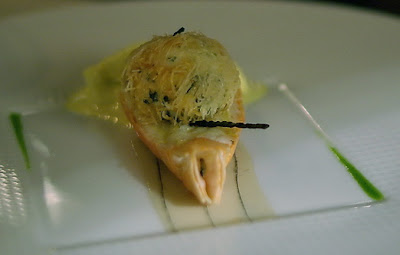
Now the same is true, in my opinion, and to a wider extent, of that equally infamous sweetbread. It is roasted on lemongrass and has the most amazing flavours in itself. Serving it on some salsifis also makes a lot of sense. But then the whole subtlety of that dish is overshadowed by a ridiculously strong sauce based on seven different herbs, and also on a very generous use of vinegar. It's not that this sauce did not bring anything to the sweetbread. It actually damaged it.
Truffle is a must in this kind of restaurant at this time of the year. And Ledoyen probably got the best truffles you can find. If that is true (and my experience this year says no different), then it is confirmation that this was a bad season. Mostly those truffle smelled great but tasted close to nothing, not unlike the ones we had earlier in the month at les Ambassadeurs and at La Régalade. That said, I don't think that such a top restaurant should serve truffle at all when they are of unsufficient quality. And at any rate, they should definitely warn serious clients like us. Indeed two truffle based courses were disappointing: a puff pastry one, with an incredible smell at the first bite and nothing after that, and a scallop one that was unremarkable. Expensive disappointments.
(crispy pineapple dessert)
Those disappointments also have to do with a service who does not seem to worry too much about the time sensitivity of dishes. On many occasions, I barely ate warm because we were waiting for the courses of others to arrive or for the explanations and preparations to end. Now this is no major drama, but this reinforces the idea that this is not a food nerd place, unlike l'Ambroisie, l'Arpège, Gagnaire or les Elysées.
While ingredients and technical quality are at the highest level, recipes are more refined than intense, and they are clearly more geared towards being pleasant than maximising their impact. They actually make for a gentle, subtle, very civilised way to accompany an exquisite moment. In that way, Ledoyen is the ultimate super-date, proposal dinner. It is impressive yet warm, high quality yet not distracting. It is a unique place that seems to prolounge an old conception of fancy dinner, using exceptional ingredients and state-of-the-art techniques. At stratospheric prices (count 300 to 400 eur per person).
Desserts were extraordinary. In particular that caramel based one was incredibly intense and subtle -- actually too strong at the end of a degustation meal, but the whole table ended up sharing it. The pinapple iced soufflé was, on the opposite, incredibly light and flavourful.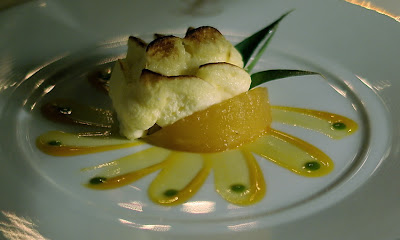

mardi 18 mars 2008
Whose fairy tale exactly?
"You say yes to Hillary and you won't have to worry about your future", said Bill Clinton somewhere in a townhall meeting in Pennsylvania yesterday. Who's telling a big fairy tale now?
Les Magnolias
Les Magnolias is the restaurant of Jean Chauvel, a 33 year-old talented chef who has an exemplary and fashionable background (the Conticinis at la Table d'Anvers, Christian Constant at le Crillon), and claims to deliver a "creative version of the French gastronomic cuisine". He is abundantly talken about as he offers a clearly creative menu for 55 euros. I finally had a chance to visit the place and taste its funny-named dishes.
In a way, the amuses were very representative of the what the meal would be: there was a cylinder of beet jelly with some sparkling powder on top, and a leaf of parsley. It sure is funny when it pops in your mouth, reminiscent of childhood memory. But this bit was not interesting in any way. It came with a pumpkin a mozzarella soup yet, which was very good and very subtly made, the liquid mozzarella creating an unexpected perfect match with the sweet pumpkin soup, giving it the little oomph that it naturally misses.
I mentioned funny named dishes: take this starter of snails, the highlight of the meal. As you see, it is designed as a little walk of snails. The walk (sortie) is called "risquée" (risky), which I guess reflect on the fact that the snails are now dead. Now those snails are in a fried ball, under their shell. The shell is filled with some sort of garlicky vegetables in mayo. It is lying on a "sod": cubes of brocoli in jelly. The whole thing is "under a rain of lettuce": they come with a little watering-can and pour lettuce juice over your plate. On the side is a lettuce soup with snails inside, and an additional fried snail ball.
Now this is a funny idea. But it is mostly a very good dish, based on a now very classic recipe -- snails with green. Remember Loiseau's nettle soup? Well, that's very close. And it is well made, with very fresh, very well cooked broccoli, decent lettuce juice. So the design does not impact the quality of the food overall. That is, if you except that it is very complicated to eat (brocolis cubes to big for a bite, while you off course have to take those big snail balls in one bite), and it is so big that by the time you reach then end of it, it is cold and soggy.
Then came another example of how a funny idea, even well executed, does not necessarily make for a good dish. They call it "sandwich jambon beurre à boire", and it is served in a funny glass including a straw, on which they spectacularily grind some toast. It does taste of ham and butter, and vaguely bread. It seems to be some ham-infused cream thickened with butter. It is funny and hard to not drink entirely, especially since you have to drink the whole think before you reach the crumbs on top, since your straw comes from the bottom. But honestly, it is just disgusting.
The main was called "violent passion of a guinea fowl". No idea what is violent or passionate about this course. The main theoretical attraction is the "émulsion de gratin dauphinois", a liquid potato gratin. In effect, it is a creamy sauce with a vague potato flavour. It mostly demonstrates, a contrario, that the "Gratin dauphinois" appeal is largely about texture. But it comes on top a low-temperature cooked guinea-fowl breast. Very good meat there, maybe very slightly undercooked. The rice chip on top is a great idea, more so than the celery slice at the bottom and the citrus confit. With the "liquid gratin", the chip and the tender and juicy meat, this course has a nice balance of texture. More interesting is the second plate: the dark meat (more tasty of course, perfectly cooked) lies in a bergamot juice, the same liquid gratin and fine rice chip on top.
The whole thing is served with a very traditional, very unsurprising potato purée, with little potato bites inside. And then, as a final note, there is that green tea with spice and oranges, and finally a simply brilliant sweet macaron with mustard, finishing on a hot and sour note, bringing together two unlikely flavours.
The dessert was less interesting, if at all. Small cylinders of chocolate and passion pudding are hidden under bits of thin white and dark chocolate, with coconuts. The whole thing lies on a bed of passion fruit and a ball of very good sorbet. It's good, nothing noteworthy. Very nice, very personal wine list. The whole place is located in an unlikely suburb. All in all, it is a good restaurant, at good prices, with some uninteresting manierism.


lundi 25 février 2008
And what would that substance be?
You know, they (clintonites in particular) say that Obama has no content. What do they mean by that? Well they mean he has no precise plan about the things he wants to do, the legislations he wants to pass. In a word (Hillary's), he does not offer "solutions", by which you should understand a description of the world as it should be.
There is first the little problem with that assumption that it is untrue and unbased. If you read Obama's book or his website, you can see that he has precise ideas and proposals on every topic, that he worked and thought through the issued that our world is facing.
But honestlty, I would argue that the existence of detailed plans is not what matters. One of the reasons I support Obama is precisely that he does not offer "plug-and-play" solutions the way Hillary and other traditional politicians do. When was the last time in Western Europea that a politician elected on a programme actually implemented it?
As Obama says, there is no shortage of good ideas. There actually even is a clear consensus on what should basically exist: affordable healthcare, pro-growth policies, pro-civilisation foreign policy, ending the Iraq war, etc. Everybody agrees that the real problem with change is "how do you get there". Everybody also agrees that the main reason why necessary change does not happen is the stability of political antagonisms and blockages. There are things politicians can't do because they wouldn't be reelected: upset the interests who finance their campaign and upset the voters.
I would therefore argue that the only way to create change in this political environment is through popular support. It has to be bottom-up. It is a very basic, very logical conclusion of political technology. It is definitely what makes Barack different: the popular support which, contrary to what "they" say, does not rely on magnetism or oratory skills, but on a precise idea of how to achieve conciliation.
What makes Barack different is both a mastering of what conciliation means and implies, and a capacity to mobilise people around those ideas and to share them. The hope that Barrack carries is a widely shared reasonable vision, a wide concern for how change can actually be implemented as opposed to a focus on how things should be regardless of what can be done (see Nader). On that, he is full of substance and his track record is remarkable. On that he is the most experienced and most skilled candidate.
But I had another point, as stated in the title: when you propose people "solutions" and "programmes", a description of how things should be, you don't hold anything concrete. What you offer is ideology, or "fairy tale", to quote Bill. And it is true that Obama
is awfully weak on ideology and pre-conceived solution that you should fight for.
Traditional elections, and traditional politics, tend to be Stalinian negotiations: here is what I want, this is not debatable. And the opposition of fixed blocks is the indepassable horizon of the political fights.
Because Obama does not offer the kind of thinking waiver which we are used to consider as political concreteness, some assume that he has to be all about words, or even worse, all about mesmerising crowds. We're that close to calling it Voodoo magic. But that's the exact opposite of it: a belief in intelligence, a belief that people can own their government and be concerned and involved in the difficulty of the choices it faces.
lundi 11 février 2008
Bernard Loiseau

La version française est ici
Being (or having been) a Bernard Loiseau afficionado does not make it easy to judge today’s Relais Bernard Loiseau in Saulieu. The place is incredibly luxurious, really unique. It is now what the great chef intended it to be: a country side palace. There’s a spa, an attention of tha staff to every detail, noble yet rural matters abund, the garden is somptuous. It is a country house for happy billionaires.

But what about the restaurant itself? As a “before” and “after” regular, I am often asked how the restaurant survived its master. Leaving aside the unprecedented level of luxury I just mentioned, I would say that the main difference between Bernard Loiseau and his successor Patrick Bertron, who was has been his sous-chef for twenty years, is simple: Patrick is a cook, Bernard never was.

Of course, he was a cook – he cooked. But he had no interest in the art of the cook, the techniques, the traditions. He was above all an exceptional palate and insatiable perfectionist (as Chelminski showed well in his book). He wanted food to explode in your mouth, to be dazzling.

(Those are pig trotters fried balls, very warm and runny inside, made on order, yum)
From that point of view, the chefs he was closest to were Pacaud and Passard. The endless complexity of the simplest ingredient, when carefully picked and prepared, was his focus. There is undoutedly something left of that spirit today in Saulieu.

See for instance this soup of Jerusalem artichoke. It is pure Loiseau style: only the vegetable, water and salt, and a lot of work. There is a drop of hazelnut oil, mostly for décor, and Jerusalemen artichokes chips, because no one can stand the excessively simple soup. Yet the soup is the culinary demonstration. The texture would make you believe there is foie gras inside. The soup captures the flavors, which are sophisticated and numerous. Hazelnut, chestnut, artichoke, foie gras… what’s not in the topinambour?

Senderens for instance has the same focus on the sublime brutality of the sheer ingredient. But sophistication and the art of the cook kick in under the form of unexpected and wonderful little “enhancing” or “highlighting” details, like those dices of celery and walnut with the yellow wine foie gras. Loiseau complexity comes from simplicity only. There are no secret spices, no taste enhancer of any sort.

(The hotel-restaurant across the street is very nice too)
Bernard Loiseau was not a cook because his specialties were not recipes: they were sunny side eggs, graded carrots, vegetable soups. “Fuck you” he said to those who mock his non-mastering of traditional techniques, “I can’t make a Béarnaise but I am the best”. Indeed. And those who mocked his skills included such incredible cooks as his former boss Jean Troisgros in Roanne, who once said that Bernard was as much as a grand chef as he, Jean, was an archbishop. I guess Jean was somewhat of an archbishop after all.

(Contemporary micro toast of Jambon persillé – typical burgundy charcuterie, with a hint of mustard)
I am pretty sure that Patrick can make a Béarnaise. He can probably make anything, just like Alléno or Troisgros. He’s a real cook. One who, for over twenty years, made sure that the food coming out of the kitchen in Saulieu was in that punchy, ignorant and genial style which the boss liked.

Patrick’s style is not that rude. It sure does rely on exceptional ingredients, like only few restaurants in the world actually use. And he also respects the basic principles of “Loiseauism” like the use of vegetable purées to thicken the sauces, the exclusion of butter, cream and flour, and some reduction of the number of ingredients.

See for instance this porcini toast, a Bertron creation: a very simple slice of pain de campagne is soaked in porcini juice, toasted. A porcini marmelade is spread on top of it, fried porcini and poeled porcini, and then a little salad. There’s some reduced porcini juice and pinenuts in the plate. Now this is very good, but it is also much refined and sophisticated than some actual Loiseau. The theme is only one ingredient, but there is at least five different textures. And there are actually four ingredients and distinct tastes: bread, pinenuts and salad are also instruments in this mushroom symphony.

(That’s the new interior style. To each its own. But it is ugly)
Another recipe that would have been too complex for Loiseau is that incredible Lièvre à la Royale. People sometimes argue as to which is the “real” lièvre à la royale: the one that is boned, stuffed with foie gras, and looks like a big sausage (often referred to as “Ali-Bab” because he codified the recipe”); or the hare stew sometimes called “du sénateur Couteaux”. Well you don’t have to chose here. Betron offers both, and they are just amazing.

The stew is the more intense one, it is somewhat sweet and almost scary. But the “paté” is no rabbit either -- . It is gamey, by which I mean it tastes like death. In a good way. Both sauces are thickened with blood, which reinforces that aspect. On the side are trompettes mushrooms (my favorites, but don’t tell anyone) wrapped in a crispy beet cylinder – it brings both the traditional sweet on the side of a game dish and the crisp which this recipe lacks.

And there are mashed potatoes. You don’t realize if you eat it with the hare, for which it is just some sort of funeral pillow. But if you eat it by itself, it is an unexpected return of the Loiseau style: it is intense and actually quite moving, tasty without the whole lot of butter used by others. It expresses the potato, its natural, non reinforced, onctuousness, the fruit of the earth. The texture is not as light as the famous Robuchon thing, but it is also easier to digest, and mostly it is a real “purée”, not a potato-based sauce. And it is just the best I ever had.

This synthesis of modernity and tradition is in my opinion the best of the Bertron style, building on both the Loiseau basics and the tradition in order to create his own style, sometimes wonderful (like with the hare or the toast), sometimes merely admirable (like with this quince-based dessert, sweet red pepper, Garam Massala spices and a laurel icecream).

Unlike Loiseau in his last years, Bertron is still on the move, still inventing his own style. He is obviously in the process of inventing his signature dishes. Meanwhile, he offers a mix of masterful dishes and “palace-y” recipes which do not enrich our lives.

(A pre-dessert: figs, frozen hibiscus, mint emulsion)
I’d like to talk about another Loiseau signature dish which is still on the menu in Saulieu: the Saint-Honoré cake. It is a very classic French cake, made of profiteroles filled with cream. How could you reconcile that and the Loiseau style, which strives for dazzling and explosion? You can’t of course. Saint Honoré is, in and of itself, bland.

Well, Loiseau’s Saint Honoré is no exception. There’s nevertheless a crème anglaise which seems to be made with low fat milk and tons of vanilla bean, much tastier than it usually is. But Loiseau compensated the lack of taste of the cake by a play on texture, and the textures here express absolute freshness. The cake is cooked on order, and it has the unique onctuousity of pastry that has just been cooked (and is yet somehow cold). Same with the biscuit bottom of the cake, and the whipped cream in the middle. You don’t feel the butter in this Saint Honoré. It is replaced by freshness.

Patrick Bertron, Eric Rousseau: show must go on