Agrandir le plan
English version coming soon
Maisons-Laffitte, ce petit paradis presque inconnu, au bord des Yvelines... Il y a ici une belle maison bourgeoise, une vraie, comme on ne s'attend pas à en trouver à 15min de l'Etoile. Tous les jours, c'est comme un déjeuner du dimanche chez une vieille tante fortunée: sa belle demeure impeccable et cirée, avec un grand escalier tout vernis, des bibelots et des tapis, des lambris impeccables, un gentil labrador, un vieux chef qui connait la chanson, et aussi la profession.
Et puis comme vous le voyez, au premier rayon de soleils, il y a les tables non seulement sur la terrasse mais encore dans le jardin, séparées par des petits bosquets.
Mais ça n'est pas tout. Dans une attraction comme ça, on pourrait s'attendre à des prestations culinaires un peu relâchées, confites dans leur certitude et leur approximation. Au lieu de ça, on a une longue carte très classique et très bien réalisée et plein de suggestions du jour. Ce jour-là, il y avait raviolis de homard -- ça ne se refuse pas. La pâte est fine, parfaitement dosée entre ferme et fondant, le homard est ferme avec ses fibres bien serrées, et mes quatre beaux raviolis sont posés sur un beau lit d'épinard frais juste "tombés", un jus de crustacé joue plus les assaisonnements que les sauces.
Classique de la maison ensuite avec une belle pomme de ris de veau pommes/câpres flanquée d'une invraisemblable charlotte de macaronis aux girolles. Quand on commence à voir des structures faites en pâtes, on sait qu'on a changé de dimension. Même si, dans le fond, des macaronis juste cuits à la minute avec leur girolles auraient été meilleurs, le charme de cette présentation à la Escoffier est imparable.
On est d'autant plus emballé, ceci dit, que la cuisson du ris est vraiment parfaite (chapeau, ça n'est pas si courant même dans les grandes maisons), et que l'équilibre de la recette, sous ses allures balourdes (du ris, des pâtes et des champignons), est assurée par l'acidité des dés de pomme et des câpres.
Et puis le portrait ne serait pas complet sans un annuaire de cave qui a tout bon dans la grande tradition, vins jeunes et vieux, châteaux alignés comme à la parade, Raveneau et Trimbach, conseil compétent. N'attendez pas de vins exotiques, néanmoins, à moins que, dans l'esprit de la maison, le Languedoc ne soit pour vous la quintessence de l'hétérodoxie vinicole.
Bien sûr, c'est pas donné. Mon repas d'hier soir était à 151€ pp avec un millefeuille et une bouteille de Cassis blanc. Il y a un menu dégustation à 95€, et un menu du déjeuner en semaine ("menu d'affaires") à 45€. Mais le dépaysement, et le charme certes discret mais surtout éternel de la bourgeoisie, est à ce prix, du moins tant qu'on reste à portée de vue de la Tour Eiffel.
jeudi 4 septembre 2008
Le Tastevin, gloire de la grande bourgeoise française

mardi 20 mai 2008
Gérard Besson: la tradition, ça a du bon
The English version is here.
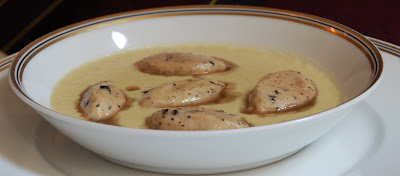
Il y a encore à Paris un restaurant étoilé où on peut manger des quenelles truffées dans une soupe d'asperges, où le chef fait une omelette, et où il y a un chariot de desserts avec Saint-Honoré ET Paris-Brest. Gérard Besson est un chef classique impeccable, un MOF au classicisme unique -- je ne lui connais pas de concurrent à Paris.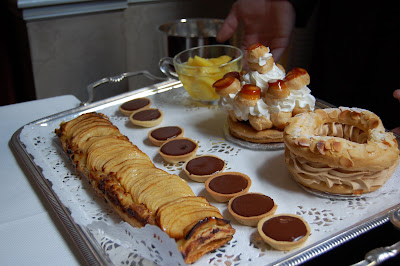
Le menu du déjeuner est une belle affaire. Cette saison, Gérard Besson avait les seules bonnes truffes que j'ai rencontrées. Besson est un initié de la truffe: il sait où les trouver, comment les négocier, comment les choisir. Oh, et il sait aussi les cuire, et qu'il y a différentes façon de le faire, ainsi que le suggère la page entière de son menu dédié au diamant noir. C'est de la truffe qui embaume la pièce. Certains soirs d'hiver quand le restaurant est plein de clients et de truffes, il paraît que certaines femmes s'en trouvent mal.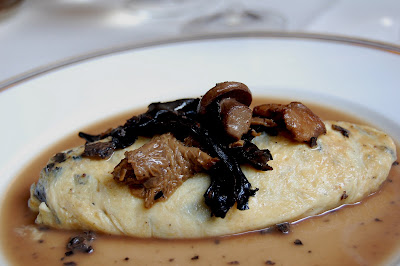
C'est une cuisine à l'ancienne, mais pas celle de Rostang ou d'Escoffier. C'est avec Bocuse que la parenté est la plus apparente, ancrée dans les recettes et les alliances classiques, mais simplifiées, épurées. Ptipois, à qui je vole sans vergogne la moitié de mes idées (et l'autre moitié de ma femme), avait un pigeon qui, aux standard modernes, était surcuit. Mais, dans cette recette avec le foie gras, il n'aurait pas pu être meilleur s'il avait été rosé, comme on l'aime et l'attend de nos jours.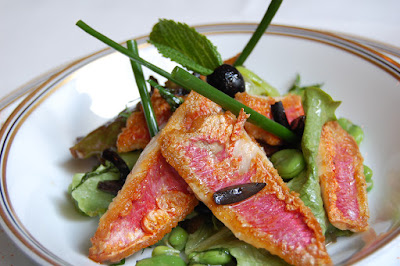
Ce plat de rouget était une célébration du printemps, févettes, menthe, salade et olive. C'est d'abord un des plats les plus simplement beaux qu'on m'ait jamais servis, et j'espère que la photo vous en donne une vague idée. Je ne pouvais m'empêcher de penser au choc que ce genre de recette a dû être au temps des frère Troisgros et de Bocuse, quand on réinventait la cuisine traditionelle tout en la respectant scrupuleusement, mettant les ingrédients au premier plan comme jamais.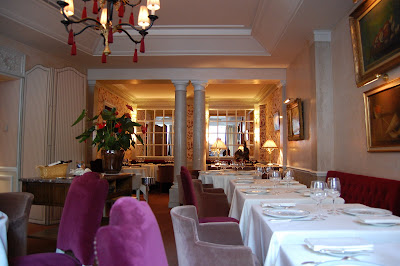
C'est un vrai endroit de gourmands. Il ne faut pas venir ici pour l'innovation. Mais si vous aimez la truffe et le gibier, si vous croyez que les grands classiques, basés sur les ingrédients de saison, une exécution parfaite et, oui, un peu de tradition, ont encore de l'avenir; alors Gérard Besson est pour vous. A la table d'à côté, un célèbre grand gourmand, beurré comme un petit Lu, avait l'air d'apprécier autant que nous les petites cailles que le chef avait fait venir spécialement de la Dombe pour sa tablée de jouisseurs contents. L'odeur de ces cailles... j'aurais voulu faire partie de leur société pas si secrète.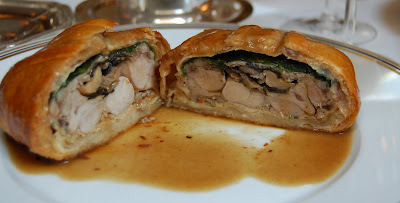
J'oubliais de vous parler du lapin en feuilletage. J'aurais dû...
mercredi 14 mai 2008
Paris, Robuchon: Table or Atelier?

When in Paris, there are two ways of tasting Robuchon branded-food: one is the most famous Atelier, which I reviewed a few months ago. The other is the more discreet and conventional La Table, in the 16th. It is more conventional because, as the name suggests, there are tables. And you can get a reservation. And there is service. Some pretty excellent service, actually. I think what impressed me most is when they brought an extra pair of spoons, having noticed that we were tasting each other's courses. Oh, and also, they don't rush you out by sending you everything you have ordered at the same time.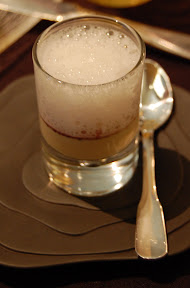
Another significant appeal of La Table is the best of all Robuchon traditions: a very affordable lunch menu, including wine, water and coffee (and service of course) at 55 euro. Because I would do anything for you, I volunteered to try. It started with a very well done amuse of foie gras mousse, porto reduction, and parmesan mousse. It's testament to their style: great ingredients first, simple but subtle preparations -- back to basics.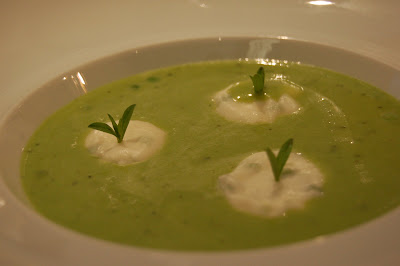
Then there was a soup of green peas with three goat cheese raviolis inside. The dough of the ravioli was so thin that it was barely noticeable, so the course was really pea and cheese. It's an interesting pairing, underlining the light acidity of the cheese, playing on a contrast of temperature as well. But it is mostly interesting because of the perfect soup, a "velouté" they call it, and velouté it is, incredibly onctuous. Indeed they do it as should be, meaning that they actually peel the peas one by one. And they blend it over and over again. And they have some very nice crème fraîche, that can't hurt. In any case, it is a demonstration that was is precious about haute cuisine is the skill and the labour more than the ingredients themselves. In general, this menu is a brilliant demonstration that top cuisine doesn't need expensive ingredients. So much so that, quite frankly, I'm not sure I even want to try their "regular" fine dining, lobster and veal chop and all.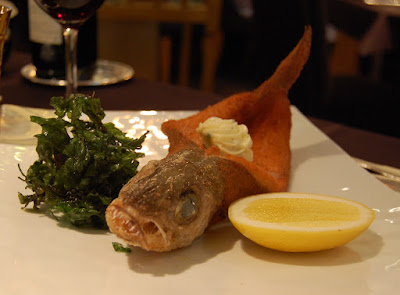
Then came an absolut Robuchon classic, the Merlan frit Colbert. It's just that great and simple -- hardly different from l'Atelier, though maybe even lighter. The fish flesh is melty and almost immaterial, the very thin crumb only protect the flesh, seasons it and, of course, crisps. Fried parsley is on the side is not lighter than air but lighter than thin paper. And the infamous Robuchon purée came on the side, as with each Robuchon course these days. There again, it felt less ridiculously buttery than at l'Atelier, where, as I wrote, it is more a sauce than a side.
My codiner, I should mention, has a codfish course that was very perfect as well, and that felt so healty that I suspect that eating it can replace fitness. 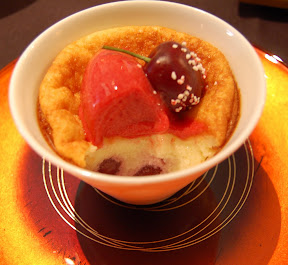
Dessert was a textbook clafoutis, not unlike the one at Jamin back in the days. One often associate clafoutis memories with guilty child memories, a rich sweet. But the Robuchon version is not too sweet, not heavy, just onctuous. Of course the cherries have their stones in, which is also part of the pleasure. Just yum.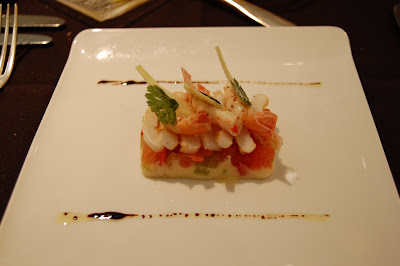
Okay, okay, I confess: I added some extras that are a big charm of the Robuchon places, where you can order tasting portions of great recipes. There was a funny artichoke/langoustine dish, with cute little langoustines that made the same irresistible impression as baby vegetables, if you know what I mean. On an artichoke mousse, there were tomato and sweet pepper dices, squid and the langoustines. There again, very fresh, very healthy, though I am not entirely sure that it is the best way to put this seafood forward. It's more like a sophisticated version of shrimp cocktail.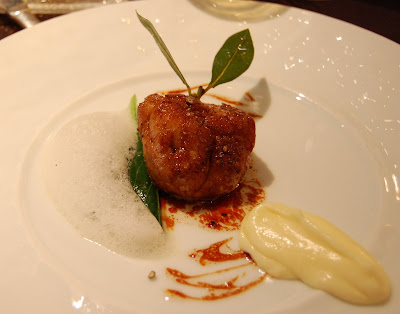
And there was also the sweetbread -- because the one at l'Atelier is the best in town, I would not go to a Robuchon place without having some. The recipe, on laurel and with Romaine, is the same at both places. But the one at la Table is more brown and caramelised, while the one at l'Atelier is almost white and so melty that it is almost creamy. It is nevertheless thoroughly enjoyable.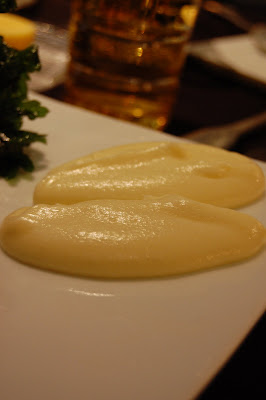
So: l'Atelier, or la Table? Well, La table's cooking is lighter, gentler and more consistent. But l'Atelier, quite frankly, still has some wows like their sweetbread. Both are excellent choices, but in different circumstances: La Table is, as you would have guessed, for a real meal. L'Atelier, really, is good for high end snacking before or after theatre or concert (plus, those are the only times where you might get a seat). L'Atelier really does not do the work of offering fine dining experience, but only some teasers to the food component of it. But all in all, la Table is a place where I plan to go regularly, especially for lunch.
jeudi 17 avril 2008
Gérard Besson: some things in France never die
La version française est ici.
There is a starred restaurant in Paris where you can still have quenelles in a white asparagus soup, where the chef cooks omelettes where the dessert tray still offers of Paris Brest AND Saint Honoré. Gérard Besson is an impeccably classic chef. A uniquely classic one, as I cannot think of any example of a comparable restaurant in Paris nowadays.
There is a really nice bargain for lunch. This season, there were also the only good truffles I had. The chef is obviously a truffle insider : he knows how to get them, choose them, negotiate them. Oh, and he also knows how to cook them, and that there are different many different, as his remarkable whole page of truffle specialties demonstrate. This is truffle that flavours the whole room – I was even told that some allergic woman just could not stay in the restaurant room one winter night.
It’s an old style of cooking, but it is not Rostang (or Escoffier) : it is actually clearly related to the Bocuse style, rooted in classic recipes and alliances, only with simplified recipes and clearer taste. Ptipois, from whom I unapologetically stole the title of this post, had thus a pigeon with foie gras that was overcooked by modern standards. But, in this recipe, it could not have been better, and a rosé pigeon would not just have been as good, strangely.
The red mullet dish was a celebration of spring, with its fava beans, mint, salad and olive. It is one of the most simply superb-looking dishes I ever had, as I hope that my picture partly reflects. I couldn’t help but thinking of the choc that this kind of recipe must have been in the early Bocuse or Troisgros days, when they were reinventing the traditional cuisine yet continuing it, and putting ingredients forward like never before.
This is a real foodie place. Of course you shouldn’t come if you’re looking for innovation. But if you like truffle or game, if you believe that the real classics, based on seasonal ingredients, flawless execution and yes, some tradition, never die, then you should enjoy Gérard Besson. We did and the table next to us, including a very famous and very drunk food writer did too, very explicitly. They had some specially ordered Dombes quail whose scent made me regret that I was not a part of their not-so-secret society.
Oh and I forgot to mention that rabbit in a blanket. I should have.
mercredi 26 mars 2008
Les Ambassadeurs: hard working dilettante

Photos John Mariani
At the end of our dinner at les Ambassadeurs, we were alone in the room, and the remaining young staff offered us to take the coffee « in the lounge » in a way that made it a bit too obvious that they were anxious to have the room to themselves. As we complied with their unspoken request and were seating in that palace lobby, I could see through the glass doors those kids playing and throwing table cloths at each other. And in a way that strucks me as exemplar of exactly how fake, how cynical and desperate that place is. At no point during that whole, rather pleasant evening, did I have any feeling that anyone was actually genuinely trying to create a special moment for me.
It’s like it was all just a game. There seems to be a common belief of le Fooding and other Ratatouilles that fine dining is a ridiculous enterprise, impossible to take seriously, that in the end the only great food belongs to bistrots. It was like this belief had been fully integrated by Jean-François Piège and its staff, running the infinitely impressive restaurant of one of the most impressive palaces in the World.
So the only resource they have left is to be at the same time ironic and cynical about their business. So most Piège dishes are based on something else than making a good dish, a good meal, something pleasant. Here first courses pretend to be like a “TV platter”. There desserts are inspired from pictures in old books, when pastry was a subdiscipline of architecture. Somewhere else, spaghetti carbonara are on the menu – such a transgression!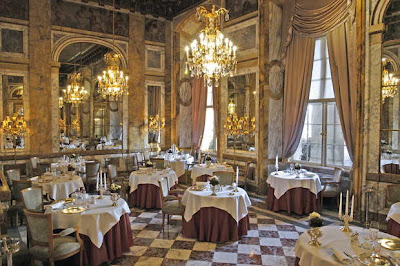
Of course there’s nothing wrong with these ideas in themselves, and I am the last person to think that a good restaurant needs to be sad and pretentious. Thierry Marx did something really interesting when deconstructing the spaghetti carbonara. Loiseau used to serve stuffed cabbage. But I think it should be good, offer a valuable experience, not a post-modern parody of one.
Take this infamous “blanc manger d’oeuf à la truffe”. On the website of the Crillon, you can actually see Jean-François Piège prepare the dish. It shows an incredible technical mastering. The white are whipped at the exact right consistency, put in a cylinder, the yok is somehow inserted inside so it just floats in the middle. This is cooked with nano-precision, and a rosace of truffle, as you can see, is added on top, and a truffle sauce around it. Of course when you start the dish, you go into the white with your spoon like into thin air, but then you reach the yok and it somehow is just warm and runny. How do you that, O master Piège? Will I, young Padawan, pathetic Karate kid, ever reach that level of sophistication and skills?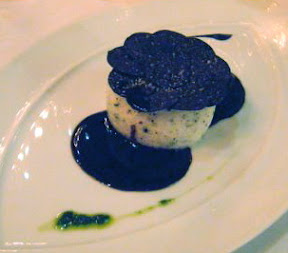
Photos Steve Plotnicki
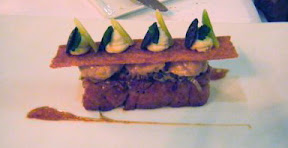
Of course nothing is bad here. One of the best things to my taste was the sweetbread “white and brown”, a very sophisticated construction, which is quite tasty, though by no mean otherwordly. The cooking is precise, though not perfect. And the presentation forces you to be creative – and careful – when eating it. A lobster dish was maybe one of the best things of the evening, inside a crispy cylinder, with a great lobster bisque on the side. It’s like a reminder that they could do great things if they wanted to.

But, you know, they’re over it, beyond that. They have menu holders and plants actually in pots, alive, for herbal teas at the end of the evening. So who needs actual top ingredients as long as they are fancy enough? Truffles were very tasteless, culminating in that double truffle salad dish. Cheeses, though from Master Anthony, were not great.
It’s too bad because they have incredible assets: this room is by far the classiest in town; it feels incredibly good. It is not as pretentious, pseudo-royal as le Meurice or Le Cinq, but it is genuinely, you know, grandiose. The wine list is full of classic wonders at reasonable prices (for a palace, that is). Dinner prices are as high as anywhere else, but the lunch menu features the same absolutely luxurious courses for an incredible bargain. If you’re interested in virtuosity for the sake of it and genuine fanciness, that is.

Desserts, plenty, not bad
It was nevertheless a very pleasant evening that we shared with the great Steve Plotnicki and his friends. He was kind enough to let me use his pictures of the dishes we had. I praise his name... and thank him.
dimanche 23 mars 2008
Exquisite and nostalgic Ledoyen
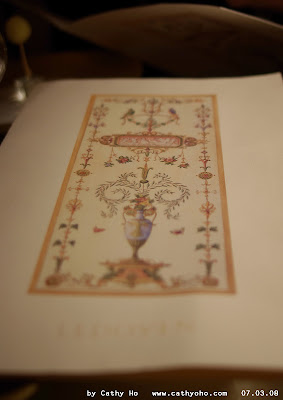
So Vedat Milor loves Ledoyen. In Gastroville, he puts is in the same league as l'Ambroisie. And I value Vedat's opinion. And I had never been to Ledoyen, mind you. So we went together for a wonderful evening. One evidence of how wonderful the evening is our surprise when we went out, that it was 2 a.m. already, and not before midnight as we had imagined. Staying home with the kids, my mother also was surprised by the late hour. So: sorry Maman, and thank you Vedat. Special thanks also to Cathy Ho, who happened to be dining at Ledoyen that night too and was kind enough to let me use the pictures that you see in that post. 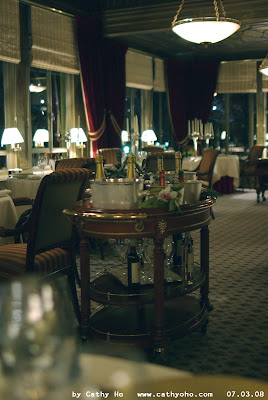
Those pictures will no doubt show you how refined and exquisite that place is. It is like the ultimate romantic, Parisian dinner spot, with its location in the park of the Champs Elysées, both in the middle of the city and country-like. The place started 1791 and, while it is perfectly decent, you sure can feel the history. In the daytime, how used the place is may even show too much. But in the evening, it is like a dream, and sure would expect Rita Hayworth and Orson Welles to come in any time. It makes it all the more surprising and, frankly, odd, that there are so many business tables.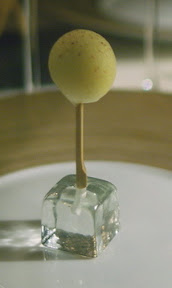
That ultimate refinement is also very apparent in both the amuse and the mignardises. If you take a close look, you will see that, like in some sort of symphony, they actually have a formal similarity. Both are four different bites, the first one like a lollipop, the fourth one on some sort of triangle. Taste wise, the amuses are particularly impressive. As Cathy noticed, they resort to molecular cuisine techniques, like this liquid mozzarella ball, or the lollipop which actually hides a delicious, juicy redmullet. But those techniques, as should always be the case with great chefs, are only used to improve the food experience, and, in that case, highlight the ingredient.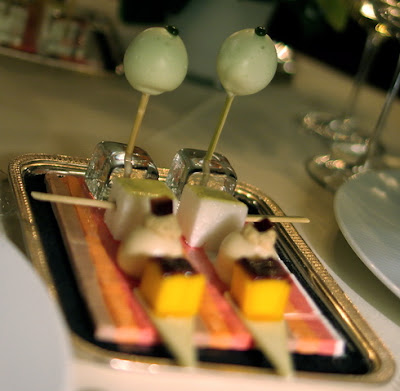
Indeed Ledoyen has top notch ingredients, on par only with l'Ambroisie or Le relais Bernard Loiseau. This was exemplified by what I considered the highlight of a very good meal, the mise en bouche of first (in the season) green vegetables. This was actually exemplary, intense, an experience that opens horizons. Those peas in particular, so incredibly fresh, so crunchy, so full of spring flavours, demonstrate what truly exceptional ingredients cooked with infinite precision and care can be. "Premier matin du monde", they could call it.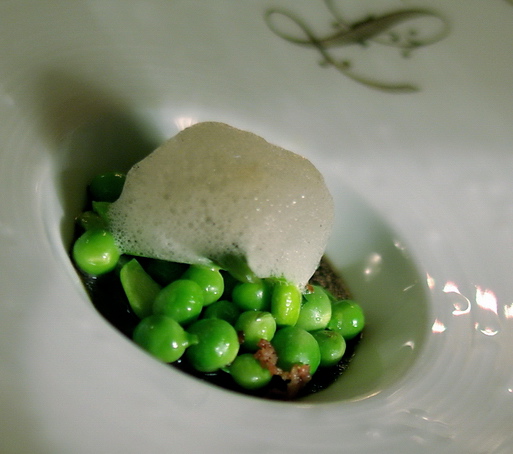
Another schockingly good ingredient (among other) was to be found in that infamous langoustine course. There are two different preparations, but the star of the show is the mayonnaise that they spread on the warm langoustine, and which dissolves slowly, strangely moving from the bland, unsurprising taste of Mayonnaise to something more subtle. There again, molecular-like techniques are used for a dish which does not try to play the wow effect usually associated with them. At the same time, this is indeed a non-wow course, and mostly, while it is very interesting and subtle, I am not sure that it brings anything to the exceptional langoustine itself.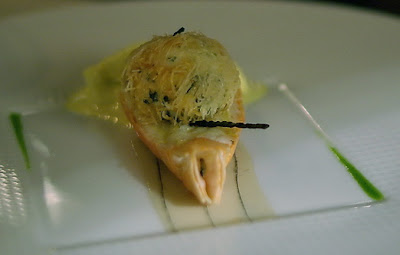
Now the same is true, in my opinion, and to a wider extent, of that equally infamous sweetbread. It is roasted on lemongrass and has the most amazing flavours in itself. Serving it on some salsifis also makes a lot of sense. But then the whole subtlety of that dish is overshadowed by a ridiculously strong sauce based on seven different herbs, and also on a very generous use of vinegar. It's not that this sauce did not bring anything to the sweetbread. It actually damaged it.
Truffle is a must in this kind of restaurant at this time of the year. And Ledoyen probably got the best truffles you can find. If that is true (and my experience this year says no different), then it is confirmation that this was a bad season. Mostly those truffle smelled great but tasted close to nothing, not unlike the ones we had earlier in the month at les Ambassadeurs and at La Régalade. That said, I don't think that such a top restaurant should serve truffle at all when they are of unsufficient quality. And at any rate, they should definitely warn serious clients like us. Indeed two truffle based courses were disappointing: a puff pastry one, with an incredible smell at the first bite and nothing after that, and a scallop one that was unremarkable. Expensive disappointments.
(crispy pineapple dessert)
Those disappointments also have to do with a service who does not seem to worry too much about the time sensitivity of dishes. On many occasions, I barely ate warm because we were waiting for the courses of others to arrive or for the explanations and preparations to end. Now this is no major drama, but this reinforces the idea that this is not a food nerd place, unlike l'Ambroisie, l'Arpège, Gagnaire or les Elysées.
While ingredients and technical quality are at the highest level, recipes are more refined than intense, and they are clearly more geared towards being pleasant than maximising their impact. They actually make for a gentle, subtle, very civilised way to accompany an exquisite moment. In that way, Ledoyen is the ultimate super-date, proposal dinner. It is impressive yet warm, high quality yet not distracting. It is a unique place that seems to prolounge an old conception of fancy dinner, using exceptional ingredients and state-of-the-art techniques. At stratospheric prices (count 300 to 400 eur per person).
Desserts were extraordinary. In particular that caramel based one was incredibly intense and subtle -- actually too strong at the end of a degustation meal, but the whole table ended up sharing it. The pinapple iced soufflé was, on the opposite, incredibly light and flavourful.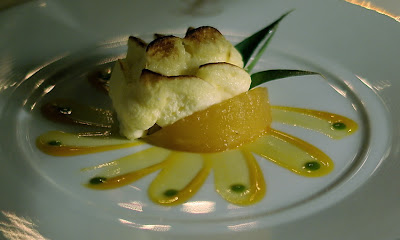

mardi 18 mars 2008
Les Magnolias
Les Magnolias is the restaurant of Jean Chauvel, a 33 year-old talented chef who has an exemplary and fashionable background (the Conticinis at la Table d'Anvers, Christian Constant at le Crillon), and claims to deliver a "creative version of the French gastronomic cuisine". He is abundantly talken about as he offers a clearly creative menu for 55 euros. I finally had a chance to visit the place and taste its funny-named dishes.
In a way, the amuses were very representative of the what the meal would be: there was a cylinder of beet jelly with some sparkling powder on top, and a leaf of parsley. It sure is funny when it pops in your mouth, reminiscent of childhood memory. But this bit was not interesting in any way. It came with a pumpkin a mozzarella soup yet, which was very good and very subtly made, the liquid mozzarella creating an unexpected perfect match with the sweet pumpkin soup, giving it the little oomph that it naturally misses.
I mentioned funny named dishes: take this starter of snails, the highlight of the meal. As you see, it is designed as a little walk of snails. The walk (sortie) is called "risquée" (risky), which I guess reflect on the fact that the snails are now dead. Now those snails are in a fried ball, under their shell. The shell is filled with some sort of garlicky vegetables in mayo. It is lying on a "sod": cubes of brocoli in jelly. The whole thing is "under a rain of lettuce": they come with a little watering-can and pour lettuce juice over your plate. On the side is a lettuce soup with snails inside, and an additional fried snail ball.
Now this is a funny idea. But it is mostly a very good dish, based on a now very classic recipe -- snails with green. Remember Loiseau's nettle soup? Well, that's very close. And it is well made, with very fresh, very well cooked broccoli, decent lettuce juice. So the design does not impact the quality of the food overall. That is, if you except that it is very complicated to eat (brocolis cubes to big for a bite, while you off course have to take those big snail balls in one bite), and it is so big that by the time you reach then end of it, it is cold and soggy.
Then came another example of how a funny idea, even well executed, does not necessarily make for a good dish. They call it "sandwich jambon beurre à boire", and it is served in a funny glass including a straw, on which they spectacularily grind some toast. It does taste of ham and butter, and vaguely bread. It seems to be some ham-infused cream thickened with butter. It is funny and hard to not drink entirely, especially since you have to drink the whole think before you reach the crumbs on top, since your straw comes from the bottom. But honestly, it is just disgusting.
The main was called "violent passion of a guinea fowl". No idea what is violent or passionate about this course. The main theoretical attraction is the "émulsion de gratin dauphinois", a liquid potato gratin. In effect, it is a creamy sauce with a vague potato flavour. It mostly demonstrates, a contrario, that the "Gratin dauphinois" appeal is largely about texture. But it comes on top a low-temperature cooked guinea-fowl breast. Very good meat there, maybe very slightly undercooked. The rice chip on top is a great idea, more so than the celery slice at the bottom and the citrus confit. With the "liquid gratin", the chip and the tender and juicy meat, this course has a nice balance of texture. More interesting is the second plate: the dark meat (more tasty of course, perfectly cooked) lies in a bergamot juice, the same liquid gratin and fine rice chip on top.
The whole thing is served with a very traditional, very unsurprising potato purée, with little potato bites inside. And then, as a final note, there is that green tea with spice and oranges, and finally a simply brilliant sweet macaron with mustard, finishing on a hot and sour note, bringing together two unlikely flavours.
The dessert was less interesting, if at all. Small cylinders of chocolate and passion pudding are hidden under bits of thin white and dark chocolate, with coconuts. The whole thing lies on a bed of passion fruit and a ball of very good sorbet. It's good, nothing noteworthy. Very nice, very personal wine list. The whole place is located in an unlikely suburb. All in all, it is a good restaurant, at good prices, with some uninteresting manierism.


lundi 17 mars 2008
Acajou: très bon, pas cher
On mange vraiment très bien au restaurant Acajou, 35 bis rue La Fontaine, 01 42 88 04 47. C'est un joli petit restaurant d'angle, avec des décorations par l'artiste des rues qui a aussi fait l'hôtel des académies et des arts. Il y a un menu à 40 eur avec un verre de vin et un café. C'est une très belle cuisine de produits, où des ingrédients très frais et de très belle qualité s'expriment superbement, tous bien identifiés et mis en valeur par des combinaisons bien maîtrisées.
Ce jour-là, une brochette de Saint Jacques avec des tomates cerises, des petits champignons de Paris, des courgettes et des échalotes sur un nid de roquette parfaitement assaisonnées. On ne peut pas manger de tout dans une seule bouchée, mais toutes les combinaisons marchent superbement.
Ensuite un pavé de bar parfait, juteux et brillant, avec un petit coulis d'épices qui, en fait, laisse le poisson intact en bouche mais interagit superbement avec la purée de carottes jaunes qui accompagne. Celle-ci a tout le goût de fruit du légume cueilli la veille, et toute l'onctuosité de la purée de pomme de terre de Robuchon, qu'on attend aussi bien avec des carottes et presque pas de beurre. Des jeunes feuilles de betterave amène un contrepoint sucré presque génial.
Le dessert, c'était un financier maison, croustillant dessous et riche mais pas gras dedans, un sorbet de citron superbe, et une très jolie rosace de quartiers à vif de pamplemousses jaunes et rouges. C'est très joli mais il y en a trop par rapport au financier. Le tout est posé sur un jus au basilic qui unit intelligemment le tout.
Bref, c'est une petite maison pour de la grande cuisine pas prétentieuse. Je ne lui connais pas de concurrent à ce niveau de cuisine et de prix.
mercredi 10 octobre 2007
Senderens, champion de l'amour

 Senderens, anciennement Lucas Carton : un restaurant de légende, où ont été formés les frères Troisgros ou Paul Bocuse. Classé à l'inventaire des monuments historiques. Dans les années 1980, le restaurant fut acheté par un des plus grands génies de la nouvelle cuisine, l'inventeur du homard à la vanille, du canard Apicius, et du foie gras cuit à la vapeur dans une feuille de choux, entre autres plats-phares.
Depuis une bonne vingtaine d'années, ledit génie -- Alain Senderens, donc -- concentre son palais incroyablement fin, sa vaste curiosité et son imagination considérable à l'accord mets-vins. Il cherche le meilleur vin possible pour un vin donné, à moins que ce ne soit le contraire, comme lorsqu'il adapte le mélange d'épices dans le Canard Apicius pour mieux aller avec le Banyuls caves de l'étoile de l'année suivante.

En 2005, Senderens a spectaculairement "rendu ses trois étoiles", fermé Lucas-Carton pour réouvrir à la place un restaurant ouvert tous les jours, avec un ticket à 100€ au lieu de 400€ (Lucas Carton était un endroit très cher). Il servirait, annonca-t-il, de la sardine à la place du turbot, et le service serait plus simple. Une fois de plus, Senderens initiait une tendance que des chefs comme Christian Constant suivraient. Renoncer à la porcelaine et au linge de luxe habituellement associés à la haute gastronomie (des points sur lesquels des restaurants indépendants ne pouvaient pas gagner face à des palaces comme Le Meurice) fut financièrement bien inspiré pour ces chefs.

 Côté cuisine néanmoins, passer du rythme et des manières d'un grand restaurant à celles d'un restaurant plus ordinaire n'a pas été aisé. Constant, qui a créé un endroit très agréable, n'a pas su maintenir un niveau de cuisine même vaguement en rapport avec ce qu'il était. Senderens au contraire a réussi admirablement dans son nouveau restaurant. Le perfectionnisme scrupuleux de l'amirable Frédéric Robert, chef des cuisines, des dernières années de Lucas-Carton et de la première année de Senderens n'y était pas pour rien. Les plats des débuts de Senderens étaient aussi éblouissants et merveilleux qu'au Lucas-Carton. Mais ensuite, Robert est parti pour la Grande Cascade et le nouveau chef, venu de l'Ambroisie, a apparemment eu un peu de mal à s'adapter au débit élevé et au très subtil style de Senderens.
 La bonne nouvelle est que, à en juger par ce dernier repas, cette période de transition est révolue, et il est à nouveau possible de goûter à la cuisine d'un des plus grands génies français pour un prix qui, s'il n'est pas donné, est un tiers de ce qu'il fut. Sept jours par semaine et même (un peu) tard le soir.

 Il y a néanmoins un point sur lequel Senderens ne peut concurrencer Lucas-Carton. Au Lucas-Carton en effet, Alain Senderens était constamment en quête du meilleur accord mets-vins possible, presque sans contrainte de coût. Il y avait donc les meilleurs vins du monde, au verre. L'accords mets-vins qu'offre maintenant Senderens est aussi fin et subtil qu'avant, mais il utilise des vins qui, dans leur majorité, ne sont simplement pas assez bons. On peut remplacer de la poularde par du bon poulet, mais aucun vin nettement moins cher ne remplace une Manzanilla El Rocio ou un autre vin exceptionnel comme ceux qu'on buvait à Lucas-Carton. Mais là encore, il y a une bonne nouvelle: la cave de Senderens est celle de Lucas, avec des marges moindres. Donc il vaut mieux, en général, prendre une belle bouteille que des verres de vins. Je vous ai mis des extraits de la carte des vins -- cliquez dessus pour les voir de plus près.
Des moules, dodues et presque sucrées, dans une émulsionde capucine, faisaient un amuse-bouche délicieux, avec ce goût qui vous fait vous demander pourquoi arrêter, juste souligné par la fleur.

La fleur de courgette farcie au crabe a des zestes d'agrume dessus, et est servie dans une émulsion d'ail des ours. Il y a une autre fleur de courgette, frite, et un petit jeton de peau de courgette, bien vert foncé et brillant. Les agrumes donnent un départ énergique, et puis le contraste des textures de la fleur et du crabe interviennent avant que le parfum d'ail des ours ne se développe avec celui, délicat, de la fleur.
C'est un plat à propos des merveilles de la nature, comme une ballade dans la compagne. C'est même un plat qui parle du miracle de la vie, dont l'ingrédient principal est un organe reproductif, qui met en scène le contraste de la fleur ronde, soyeuse et pleine, et sa version frite, dure et longue, debout dans l'assiette.

Il y avait chez Lucas Carton un plat de langoustines croustillantes tout-à-fait exceptionnel. Des langoustines impériales, presque des petits homards, étaient soigneusement roulées dans des vermicelles et dorées au beurre clarifié. On les trempait dans une crème de coquillages et des éclats d'amandes, et c'était beau comme l'antique, moelleux et croquant, iodé et sucré, des frissons partout. C'était très caractéristique de la manière Senderens: souligner la force brute d'un produit exceptionnel, en y apportant toute la sophistication d'alliances inattendues et très précisément dosées. Resquiescat in pacem. (Quoiqu'il paraît qu'ils vont remettre des plats du Lucas-Carton à la carte. Ceci dit, il me semble me souvenir que c'était un plat à 130€, plus avec le Bourgogne blanc qu'ils avaient choisis) Dans les premiers jours du restaurant Senderens, ils avaient remplacé la Langoustine par des Ganbas et ça ne marchait. La bonne nouvelle est que le plat que vous pouvez voir ici est une recréation, sur la même idée de base des langoustines croustillantes trempées dans une crème, mais repensées en fonction de la nouvelle stratégie commerciale.
Des langoustines de belle taille mais pas monstrueuses sont trempées dans la bière et roulées dans un mélange de pâte à phylo et d'éclat d'amandes. Au lieu d'encourager la nostalgie du Lucas-Carton et d'imiter la finesse virtuose de l'ancien plat, le nouveau plat se contente d'une croûte plus épaisse, plus goûtue. On trempe dans une sauce aux épices thaï qui est peut-être à base de lait de coco. Des feuilles de céleri frites apportent un peu plus de durée en bouche et de croustillant. Le Pak-Choy (chou chinois) offre la possibilité d'alléger quelques bouchées et d'essayer une variante harmonique de goût. C'est le plat qui m'a convaincu que la cuisine de Senderens avait de nouveau trouvé son rythme. Il y avait ensuire un foie gras aux morilles, pôché au vin jaune. C'est une préparation classique pour le poulet (voir la Poularde au Bristol), mais plus inattendue pour un foie gras. C'est le goût des morilles, (il y en a plein), qui est au centre de ce plat.
C'est d'autant plus ironique que, comme vous le pouvez voir, elles étaient cachées dans la sauce, cuisson réduite, crémée et émulsionnée. Encore une demi-soupe, donc, et franchement, ça commence à bien faire les émulsions et les plats qui baignent. De nos jours, les bulles et la géométrie sont le nouveau maniérisme gastronomique, et, apparemment, elles n'épargnent personne.  En tous cas, c'était encore une démonstration du grand style Senderens, simplissime et pourtant sophistiqué. Ainsi les petit dés de noix et de céleri s'harmonisent-ils parfaitement avec les notes du vin jaune, le foie gras apportant essentiellement son gras et sa belle consistance soyeuse, en opposition et en support des fermes morilles. En fait, on ne les sent pas en tant que tels, ils sont utilisés comme épices pour souligner les goûts du plat.
 Non moins typique de Senderens était le bar au fenouil, romarin et citron, un plat tout en nuances et en demi-teintes mediterranéennes. Le fenouil est servi en quartier fermes et en fines tranches fondantes, son territoire délimité par un trait de moutarde de l'autre côté duquel se tient un fier morceau de bar rôti. On verse une sauce au citron et romarin sur la ligne. C'est un plat de senteurs, avec un peu d'acidité pour le ramener sur terre.
 La règle que je mentionnais à propos des vins au verre ne s'applique pas au plat de fraises et à son Riesling "Auslese" 2004 Selbach Oster, un vin incroyable, sucré et pourtant léger (5°), et faisant une parfaite alliance avec le plat de fraises sur un parfait à la pistache, émulsion (bien sûr) de poivre, fraise et rhubarbe. Comme les moules du début, c'est un plat où on ne voit pas pourquoi on s'arrêterait d'en manger.
 Classique Senderens encore, le "coulant de Samana millésimé 2006, pur cacao de Saint-Domingue, cerise Amerena". Ca repose toujours sur la magnification d'ingrédients exceptionnels par un dosage subtil d'ingrédients associés. Les cerise, ici, sont les satellites du chocolat pour une expérience absolument intense, une de celles qui vous mi-clore les yeux.
Je crois que la comparaison la plus appropriée pour ce dessert est celle de l'orgasme féminin, parce que c'est à la fois intense et diffus. Les desserts de Senderens ont toujours été formidables, mais ceux, comme la Dacquoise au poivre et citron, qui reposent sur des saveurs plus acides ressemblent plus à la satisfaction masculine, un jaillissement qui tend à abstraire le jouisseur du monde. L'arôme de ce chocolat se répand dans votre bouche et votre nez, envoie ses ondes de chocolat jusqu'à toutes vos extrêmités, il est fort et tendre, et il vous rend plus présent au monde (Et je ne suis pas un fan de chocolat!). Cette comparaison, et cette photo, ne sont pas là seulment pour donner un sens aux mots "food porn". Peu après son ouverture, Senderens a été nommé "best before love restaurant in Paris". Ca n'est pas un malentendu. Toute la cuisine de Senderens, comme je l'ai suggéré, pointe vers l'érotisme, avec la force brute de la nature et pourtant tellement de raffinement et de culture dans les préparations. N'est-ce pas la structure même du jeu de la séduction? Le décor fait aussi partie de l'expérience, avec ses nymphettes sculptées dans le bois et ses jambes de femmes gravées dans le verre, son cuir gris satiné, sa lumière rouge. Déjà le décor, classé, de Lucas-Carton, avec son style Ecole de Nancy, et ses courbes envoûtantes avait cet aspect. La redécoration, ici, est en somme une actualisation.
Déjeuner du 2 septembre 2007. 323€ pour deux personnes, 234€ sans les vins.
