jeudi 23 avril 2009

Alive and well

De Lasserre

La version française est ici.

Lasserre is a historical monument of a restaurant. It once was ZE top restaurant in Paris (say, in the 50s?) and it still is today a solid institution, who not only keeps its standing but also has loyal regular clients. From the moment you step in, you know they take French art de vivre seriously in here. It starts downstairs with this hall like in a cozy bourgeois mansion. This lobby is transition – you wouldn’t want to enter such an institution directly from the street. You are taken upstairs, where the dining room is, in a small elevator that is of course operated by one of the waiters in tail coats – you probably couldn’t manage the technical complexity. The tiny elevator leads to the large, generously decorated and flowered dining room, its large windows and mostly its spectacular opening roof.

De Lasserre

Like the house, like their outfit, the attitude of these waiters seems to be from another time, friendly in fact, but obviously distant, professional, somewhat ironic. Don’t let the attitude fool you: they’re here to please you, and they don’t act snutty or condescending when you want the75€ lunch menu with tap water. Neither do the cooks. Unlike other top restaurants in town, the value lunch at Lasserre regularly features the top hits of the house like the macaronis, the pigeon “André Malraux”, the “timbale” or strawberry.
De Lasserre

Despite the names and the setting and the tailcoats (did I mention them?), cooking is not stuck in the 1950s. On the contrary, it is rather modern, led by one of the best Ducasse boys, Jean-Louis Nomicas, a great technician but also a genuine food lover who does not get carried away by technology or fashion. Thus among the amuses is the foie gras simply served between two crispy ginger bread slices. Beyond the crisp, they bring a discreet seasoning. The quail egg, fried, lies on a sable. At the end of the meal, small profiterolles and lemon tarts are at the same time plain but modern and light, with flavours that are clear and intense if classical.
De Lasserre

The food welcomes you like the place does: it is accessible, familiar, but it is still special and made with extreme care. This is a place where you can come as a food lover obsessed with what’s in your plate, but you can also come for a civilized meal, family or business, where the food is not a conversation-stopper.
De Lasserre

Of course, you should expect no revolution – that’s no what they’re here for. Foie gras ravioli is thus immerged in a lobster bisque that, if its taste is clear and precise, is still heavily buttered and creamed. It comes with mushrooms and foie dices that are violently seared.
Lasserre is also home to the famous Canard à l’orange, carved tableside, a recipe which does seem unchanged from the times of André Malraux. The pleasure starts, and maybe ends, with the expert gesture of a maître d’ carving the duck in a way that not totally Chinese but also not quite French.
De Lasserre

The lambi s cooked with precision, wrapped in a herb crust, with a provencal side which demonstrates the validity of sucj traditional recipes. Too often olive, artichoke and sweet pepper are convoked for some kind of tasteless stew that only masks the taste of the meat. And sometimes it is exactly what the meat needs. But here you see why these vegetables, properly used, emphasize the taste of the lamb, put it forward. The juice with sweet spices is a demonstration of ancient skills – and significant manpower (you don’t get these juices by showing up just before the meal or hiring random cooks).
De Lasserre

The 75e lunch deal is clearly one of the biggest steals in town. Even with the less friendly à la carte prices, Lasserre is still worth a detour. In its warmth, it constitutes a sharp contrast with its neighbour Ledoyen. Sometimes I think that those two together represent the best of top Parisian restaurants – the Dionysian and the Apollonian dimensions, sheer enjoyment on one side and a more contemplative approach on the other.
De Lasserre

mercredi 1 avril 2009

A good roll

De Jadis

I don't know why, but I've been on a pretty good roll lately with bistrots in Paris and elsewhere. An excellent one, actually, who reconciled me with dining in Paris -- regular readers will remember that I was slowly losing hope in the seriousness of French cooks. I was also worrying that maybe I was starting to develop the syndrom of the bored food critics, who grew unimpressed by a perfect roast chicken or anything good really, unless it is novel enough to wake him up and make him escape the boredom of his fate.
De Jadis

Turns out, I'm fine. And maybe the economic crisis made people in business everywhere, and in restaurants in particular, work seriously again. Or maybe I just got lucky. Anyway, time to share with you all those very good meals I had. I started the series, I think, after the OFF4 (about which I still have a couple of things to write, stay tuned) and an improvised lunch at Jadis: it was simple and really good, an honest, unpretentious, and very well mastered cooking -- oeufs pochés, rognon de veau, and a superb cheese platter, from no big name fromager, but sent from some shop deep down in Auvergne. Food, not names or ideas. Bravo.
De Joséphine et son pain

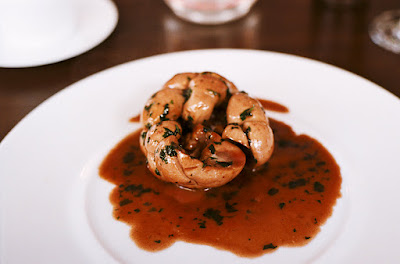
It was also long overdue, but I finally tried Joséphine Chez Dumonnet, a true Paris institution, with absolutely traditional Parisian brasserie food, and setting, and an impressive generosity. At first I thought that it did not look cheap, but then it turned out that the paté de campagne easily serves four and the canard aux choux actually consists of a whole duck, so it's actually pretty cheap after all. Also, they have a specialty of truffles (like in the andouillette in puff pastry you can see right upthere), and an excellent bread that they buy at the bakery next door (see the gallery for more pictures).
De Five guys, Bleeker street

In a trip to North America, I also let go of my fine dining/Internet researching way and hit more or less randomly (OK, with some recommendations) some very delicious places, starting with the renowned Modern Apizza in New Haven, Connecticut (best American style pizza I had), the excellent underground Thai restaurant at Fulton and Gold Street in downtown NYC, and the wonderfully "no BS" Five guys (picture), which made up for not having been to the West Coast and In&Out. You know I might actually like Five Guys even more than In&Out. I never had a burger with truly warm meat before ever, I think.
De Au Bon Accueil

Back in France, another long overdue visit what to Au Bon Accueil, a restaurant of which I only ever heard good things. At the same time, that was true of its neighbour in the same rue Monttessuy, Vin sur vin, which turned out to be pretty crappy. And I was still worried when I entered the very black and white restaurant full of old gentlemen in grey suits. But the menu was reassuring, and mostly, the food was perfect (freshness, cooking, seasoning), even in the less than 30€ prix fixe menu. I did not try, but they too appear to be versed in the dark arts of truffle, and with seriously friendly prices --their truffle and vegetable dish at ca 30€, the whole Coucou de Rennes roast for two with a risotto truffle for barely more. I'll be back, and if they confirm, it'll definitely be a new favourite.
De Au Dernier Métro

It kept going with a true bistrot like I did not think they existed anymore. Not a néo-bistrot, not a bistrot de chef, just a place where you'll eat consistently good frites, boeuf bourguignon and other standards, for less than 30€ pp for real, with wine, and dessert and all. Plus, they serve all day (don't you sometimes feel like having lunch at 3pm or dinner after 10pm without having to go to a MacDonalds or Le Pied de Cochon?) and they're open everyday. It's bd de Grenelle at the métro Dupleix. And it's called Au Dernier Métro. At that point it was clear that I was protected by the Gods, and even the new Big Mac with wholegrain bread I had at Saint André les Vergers (Aube) wasn't bad.
De MacDonalds, Saint André les Vergers (Aube)

And indeed said Gods then sent me to more places that I want to return to, and frequently if they serve me meals as good as the ones they served me the first time. In fact, I already went back to L'Auberge du Quincy chez Boboss, another institution that was new to me, and Boboss confirmed that I was not only lucky the first time. Auberge is a very tired word, but it has its meaning with Boboss, who is not only colourful but also obviously a fine palate and a demanding boss. A case in point would be the Parma ham that he has aged three years for him, or the goose foie gras that he serves (they're both on the picture because they were both on my plate, I wonder why). The Chef is former Benoit, and this is ZE place for old traditional dishes: cassoulet, escargots, pieds paquets, caillette, tête de veau...
De Le Quincy

Now something even less likely happened too: a modern bistrot, one that clearly belongs to the "jeune cuisine", as they say, actually impressed me not because of the good look of the chef or the audacity of his concept (more fashionable chefs bashing soon, stay tuned), but because of an excellent meal, with pleasant service and a wise offer of wines. That would be Le Bistral rue Lemercier, next to the Marché des Batignolles (17th). I grew up there, mind you, but that's not what made the meal special. In fact, I'll talk to you more abou that meal when the pictures are ready -- but let me tell you that the wines were natural and sincere, and the cooking, which looked unnecessarily complex on the black board, was balanced, subtle and delicious. While we're at it, I also confirmed l'AOC as an old favourite, with the caveat that this is one of those places where you have to know for themselves what they do well because they don't know it. That's particularly true of the very average beef they put forward as "bidoche" (slang for meat). But when it comes to bone marrow, to terrinnes and ham, to slowly rotissoired echine de cochon, it is solid and not even expensive.

Bottom line: it's safe out there. You may eat out again.

jeudi 26 mars 2009

Lasserre, y en pas deux

De Lasserre


The English version is here.

C’est une maison historique et unique, que Lasserre, avenue Franklin-Roosevelt. Ce qui fut LE grand restaurant parisien dans les années 1950 est encore aujourd’hui une institution fidèle non seulement à sa légende, mais encore à ses clients. Dès l’arrivée, on voit qu’ici, ça ne badine pas avec l’art de vivre. Tout commence avec cette entrée de maison bourgeoise, bas de l’escalier, antichambre – on entre pas sans transition dans un restaurant comme celui-là. La pièce maîtresse de cette transition de la rue au grand restaurant est néanmoins l’ascenseur – étroit, tapissé, et manœuvré par un des serveurs en queue-de-pie et plastron nids d’abeille qui officieront pendant votre repas – votre visite, devrais-je dire. Comme leur défroque et leur maison, leur attitude est d’un autre temps, complice mais distante, professionnelle et un peu pince-sans-rire.

De Lasserre

Mais l’attitude ne doit pas vous tromper : ils sont là pour vous faire plaisir, et ne manifestent aucune contrariété ou condescendance quand vous êtes venus prendre le menu du déjeuner à 75euro et boire de l’eau. La cuisine non plus ne vous prend pas de haut quand vous venez en mode « budget ». En fait, les grandes spécialités de la maison sont régulièrement disponibles dans ce menu du déjeuner : le gratin de macaronis, le pigeon André Malraux, la timbale Lasserre.
De Lasserre

Et la cuisine ? Elle n’est pas vraiment prise dans les années 1950. Elle est même plutôt moderne dans ses techniques et ses préparations, menée par un des meilleurs cuisinier de l’écurie Ducasse, Jean-Louis Nomicos, un technicien hors pair mais aussi un gourmand sensé, généreux et qui ne se laisse pas entraîner par sa technique ou ses idées. Dans les mises en bouche et mignardises se démontrent justement cet à-propos dans l’utilisation de la technique. Ainsi le foie gras est-il servi entre deux croustillants de pain d’épices qui, outre la texture, n’apportent qu’un assaisonnement discret. L’œuf de caille, au plat, est posé sur un sablé. En fin de repas, petits choux à la crème et tarte aux citrons meringuées jouent la gourmandise franche mais moderne, lègère, aux saveurs claires mais classiques.
De Lasserre

De la même façon, la cuisine de Nomicos, malgré sa modernité, reproduit l’hospitalité caractéristique de Lasserre – elle est accessible, familière, mais quand même spéciale dans l’extrême soin qui lui est apportée. A Lasserre, on peut venir en gourmand obsessif et ne faire attention qu’à la cuisine, mais on peut aussi venir en assemblée civilisée, en famille, sans que la cuisine n’exige qu’on stoppe les conversation pour la regarder se trémousser.
De Lasserre

Il ne faut, dans tous les cas, pas attendre de révolution culinaire, ce n’est pas le propos de la maison. La raviole de foie gras se plante ainsi dans une bisque de homard au goût précis et clair mais quand même généreusement beurrée et crêmée, avec des quartiers de foie gras et de champignons poêlés violemment. Tout cela est familier et délicieux, soigné et généreux.
Lasserre, c’est aussi la maison du canard à l’orange, découpé en salle, un recette qui, elle semble vraiment inchangé et loufoque, mais dont le plaisir commence, s’il ne finit, avec les gestes experts d’un maître d’hôtel qui découpe un canard d’une façon qui n’est ni tout-à-fait chinoise, ni franchement française.
De Lasserre

Le canon d’agneau, lui, est cuit avec précision, servi dans une croûte d’herbes, et avec un assaisonnement provençal qui démontre l’intérêt de ces recettes banalisées et souvent massacrées – l’olive, l’artichaut, le poivron, relèvent l’agneau sans le masquer. Le jus aux épices douces est un de ces jus parfaits qui démontrent qu’on est dans une maison qui connaît la musique, qui maîtrise la grande cuisine, qui sait comment tirer parti de sa main d’œuvre.
Avec tout ça, je n’ai même pas mentionné le toit ouvrant, pourtant la caractéristique de Lasserre la plus unique, l’attraction. Même par mauvais temps, on l’ouvre brièvement deux ou trois fois pendant le service. Il ne sera pas dit que vous êtes venus chez Lasserre que le toit est resté fermé. Mais dans le fond, le toit ouvrant, ce n’est qu’un accessoire à côté de tout le savoir-vivre déployé, incarné même, pas la maison Lasserre.
De Lasserre

A 75eur au déjeuner, c’est définitivement une des affaires les plus éblouissantes de Paris. Même aux prix moins amicaux de la carte, c’est une maison qui continue à valoir le détour. Elle constitue aussi un contraste saisissant, dans sa chaleur sociale, avec son voisin austère du bas des Champs-Élysées, Ledoyen. Mais je me dis parfois qu’à eux deux, ils constituent un peu le meilleur de la grande restauration parisienne – le dionysiaque et l’apollonien, si on veut.
De Lasserre

jeudi 26 février 2009

The days the Danes took over (OFF4)

De OFF 4- Day 1

So I'm back from the 4th Omnivore Food Festival in Deauville. They call it OFF4, and it was a reunion of cooks and winemakers, but while the winemakers organised tastings, the cooks organised...demos. For two days, we sat in a theatre, watching cooks cook, and even sometimes just talk, or run videos.
De OFF 4 - Day 2

I won't tell you the whole story here. In fact, I made a story board with some pictures I took. Why don't you visit it there: day 1, day 2
De OFF 4 - Day 2

Right now, I feel like there is a lot to say about this fascinating event, so I'm planning to release a few posts in the coming weeks. Meanwhile, let me give you the main message: the Danes stole the show.
De OFF 4 - Day 2

Those three young men(Redzépi from Noma, Schmidt from Mailing and Schmidt and Reflund from MR) came together to support one another, and made demonstrations of their enthusiastic style of cooking, an ode to the products of their countries and neighbourhood. While they all have very distinct styles, they share that profoundly naturalistic approach, almost a pagan cult, that is expressed only in the plate. Their attention to ingredients is stunning, and their innovation has no other goal than to best express their country. As Schmidt points out, they are plain childish in their enthusiasm, and you can tell, by seeing them cooking, that there will be joy and yet rigueur in the plate. They never aim at anything else than feeding you, and seem constantly on the move as to how to best do that in the place where they live and grew up. It's not like Trine had not been warning us for years -- but seeing those guys cook is even more compelling than watching Trine's wonderful picture.
De OFF 4- Day 1

De OFF 4 - Day 2

I never bought so much into the New York Times idea that Spain replaced France as the n°1 dining destination. But I would not oppose the idea that the center of gastronomy today may well be in Denmark. In any case, even if there were some pretty exciting cooks out there at the OFF4, the Danes almost made them all look irrelevant. Well, to be fair, some were pretty much irrelevant by themselves, regardless of the Danes' presence. Stay tuned for more, and meanwhile, have a look at the story board.

mardi 10 février 2009

Bon pain

De Ze Bread

On parle parfois du pain comme du symbole ultime, non seulement de l'alimentation, mais de la civilisation. Pourtant, les baguettes de tradition qu'on nous sert à tous bout de champ, si elles sont parfois bonnes, et même assez addictive, ne m'ont jamais paru justifier cette emphase. Mais quand, au hasard de mes pérégrinations rue du Théatre, je suis tombé sur un vrai bon pain, fait avec du levain et la farine fraîche, et avec tout le vrai savoir faire du boulanger, y compris sa faculté de s'adapter aux caprices conjugués de la météo et du levain, je me suis dit que cette apparente emphase était, en fait frappée au coin du bon sens.
De Ze Bread

Le pain que je vous montre s'appelle "des alpages". Il contient un peu de seigle et connait une fermentation très lente. Sa croûte est épaisse, très croustillante et savoureuse. Son odeur est ensorcelante comme celle d'un nourrisson pour une desperate housewife. Sa mie est élastique, presque collante quand il est frais -- il a cette façon caractéristique de revenir en place après qu'on l'ait tripoté. Frais, sa mie est crémeuse, justifiant cet autre stéréotype: "le pain est la meilleure des pâtisseries".

Ses saveurs sont longues et complexes, riches des grains de blés et de la fermentation, mais il n'a quasiment aucune acidité. Bien entendu, il se garde plusieurs jours et s'achète au poids. Il est particulièrement phénoménal juste avec du bon beurre, et pourquoi pas un peu de truffe et de sel en cette saison. Avec d'autres mets qu'on a l'habitude de tartiner, l'accord n'est pas forcément idéal. Ce pain là n'est pas là pour jouer les faire-valoirs de charcuteries ou de fromage trop gras ou trop forts, en somme pas assez bons pour être dégustés pour eux-mêmes.
De Ze Bread

Amen.

PS -- en hommage aux savoirs-faires ancestraux, j'ai pris ces photos sur film. Comme le bon pain, c'est plus de travail, mais c'est mieux.

PPS -- J'oubliais: e.Mayeur, 100, rue du Théatre, Paris 15ème, fermé le lundi.

mardi 3 février 2009

Jacques Génin : Pâtisserie vivante

De Jacques Génin

On me demande parfois où trouver un très bon millefeuille. Malheureusement, ma réponse était jusqu’alors invariablement quelque restaurant de haute volée, parce que le bon millefeuille doit être frais. Immanquablement, un millefeuille qui traîne dans une vitrine aura la pâte feuilleté toute trempée, à moins qu’elle n’ait été « blindée » par quelque glaçage ou autre artifice. Si en plus la vitrine était réfrigérée, la pâte feuilletée sera devenue toute cartonnée. Non, il y faut une pâte friable et une crème pâtissière bien fraîche et brillante. Comme le dit le héros de ce post « si on peut le manger proprement, c’est qu’il n’est pas bon ».
De Jacques Génin

Jacques Génin offre, pour la première fois à ma connaissance à Paris, dans sa confiserie/pâtisserie/salon de thé de la rue de Turenne, cette fraîcheur qui, jusqu’alors, était réservée aux clients des grands restaurants. Et cette vérité de la fraîcheur qu’il défend, il l’applique non seulement aux grands classiques de la pâtisserie – l’éclair et le Paris-Brest, la tarte au citron et le millefeuille – mais il l’étend également à la confiserie, qui est souvent la grande victime non seulement du réfrigérateur mais du garde-manger.
De Jacques Génin

Les chocolats de Jaques Génin, ses caramels, n’ont pas une date de péremption, mais une date de fabrication. Interdit de les manger plus de huit jours après conception. D’ailleurs, ceux à qui il en reste après huit jours n’ont que ce qu’ils méritent : un goût évanoui, une texture compromise, un méchant truc mort.
De Jacques Génin

Comme feu Bernard Loiseau, Jacques Génin remplace ainsi le beurre et le sucre par la fraîcheur, qui apporte l’onctuosité et la douceur nécessaire, ainsi que l’irremplaçable vie de l’aliment frais, son chi chi vous voulez, cette façon de vous chatouiller les papilles et de vous envahir le palais, de vous parler de nature et d’harmonie. Voyez ainsi les chocolats à la menthe de Jaques Génin, comme une légère infusion de menthe fraîche, pas un After Eight qui pique le nez, mais une caresse chlorophyllée, dont la durée en bouche dialogue avec celle du chocolat, tout aussi frais.
De Jacques Génin

Inutile que je vous parle aussi des caramels, des rochers, et de la tarte aux framboises. Allez-y et ne gardez rien que des souvenirs et de l’envie. C’est aussi un salon de thé ridiculement spacieux, concentré sur la qualité des thés et du service autant que sur la pâtisserie. PS: c'est Bruno Verjus qui m'a filé le tuyau. Sacré gourmand, celui-là.

Jacques Génin, 133, rue de Turenne, 01 45 77 29 01, fermé le lundi. Même pas très cher, avec l'éclair (de compétition) à moins de cinq euros.

mercredi 28 janvier 2009

Ledoyen : inside the noodle castle

De Ledoyen

One of the biggest fallacies of food critic these days is the notion that one visit is enough to know what to expect from a restaurant. I am guilty of this myself, as evidenced by my former post on Ledoyen, among others. I blame the overall competition between bloggers, and my misplaced ambition, for sometimes posting reviews on restaurants I don’t know well enough.

In any case, at Ledoyen last December I had one of the best meals I’ve had in a long time. What struck me was the search for perfection in cooking, the utmost seriousness, which, as I have been arguing lately, I find lacking in most restaurants. What happened to the idea that a top restaurant is, you know, top? That it should only offer you the best there is? My sense was, Le Squer at Ledoyen often succeeds where the Pacauds and the Passards of this world don’t even try anymore, to busy that they are imitating themselves.
De Ledoyen

It started with an amuse that was exactly what I expect from very fine dining, showing how ordinary ingredients treated with skills and care can create a wonderful experience. On an onion purée, which was in itself poetry, capturing the flavour of the onion while being absolutely smooth and gentle, came a simple crispy parmesan tuile, and a quenelle of rosemary sorbet on top. Three raisins surrounded the tuile. The whole thing, like food that has been prepared with utmost care and sensitivity, was fresh and exciting and almost told a story to your taste buds, it had several dimensions, sweet and sour, crispy and melty, warm and cold, but mostly had that harmonious, musical way to evolve in your mouth from the moment you bite in to the moment the last flavors dim.
De Ledoyen

A cause for anticipatory satisfaction was that I ordered the 88€ prix-fixe lunch menu. But the real good news is that this lunch menu is nothing less than your regular Ledoyen food in terms of the care and the quality of the ingredients. The first course for me was the “oeuf fermier soufflé à la truffe”: the white is whipped then the yolk is reintegrated in the snow-like white inside a cylinder mold in which the whole things cooks. It is therefore lighter than air (or, to be fair, every bit as light as air, since that is what it is), and has a heart of warm and runny yolk of high quality egg. And there are some truffles on top. So far, it sounds pretty much like the Piège dish (at les Ambassadeurs) I made fun of last winter. It is, actually, the same. But this dish made very apparent why Piège is busy admiring himself and le Squer wants to make good food. It was nothing, really: a crisp of parmesan on top and a creamy truffle sauce at the bottom, but it changed the dish from a cold beauty to a frickin’hot babe, if you’ll allow me.
De Ledoyen

As a starter in the lunch menu, I could have had what my neighbors had: they call it “quenelle de merlan”, which is a bit misleading as the said whiting quenelle has great scallop, langoustine and lobster on top. The bites I had were pretty awesome, truly exceptional seafood and mastered execution.
De Ledoyen

The main was a sweetbread on salsify and truffle sauce which I’d call not only perfect, but also better than the regular A la Carte sweetbread, which is yet a Ledoyen’s signature dish. As I reported last time, the herbs and vinegar sauce in the regular sweetbread dish overpowers, in my opinion, the specific taste of the sweetbread, especially the delicate balance achieved by having roasted the sweetbread with lemongrass skewered. In contract, this very classic alliance of sweetbread and salsify could be called a marriage made in heaven by someone less afraid of stereotypes. Now a creamy truffle sauce (yes, like in the starter) makes everything better, and it worked with that dish too.

At that point, I need to confess that I annihilated the financial benefit of having ordered the lunch menu by supplementing it with a dish who, by itself, was more expensive than the menu itself. Worse again: it was a plate of pasta. A 90€ spaghetti dish. Totally worth it. As can see, calling it a spaghetti dish, if technically correct, is misleading. It is a sophisticated construction involving spaghetti, and some dices of ham, and also some nice dices of truffle. Inside the “noodle castle” is the sauce. Of course the dish is decadent. In fact, it should be subtitled “Twilight of the gods”, given as it equally consists of a castle being destroyed by lust and desire.
De Ledoyen

Other proofs of a style made of absolute technical mastering and food loving included an eel dish, of which I only had a bite, but that was based on a red wine sauce and offered amazing sophistication and balance. The dish was powerful and yet the subtle own taste of the eel was absolutely apparent through the acidity and sweetness of the red wine, which were like backed by the toast on which the eel was served.
De Ledoyen

As I write this I’m thinking “isn’t it the best restaurant in town? Isn’t it exactly the utmost serious restaurant offering perfect preparations of awesome ingredients?” Well, to a point it is. But I would have some issues some Ledoyen before I can grant them the “best in town” status.
De Ledoyen

First, sticking to food, there are some plain bland dishes, which seem to be here more to make a statement than to produce actual satisfaction. In my first report I mentioned a few, and this time, two belonged very obviously to that category: the first one was white truffle and “gnocchis soufflés”. The white truffle, shaved in the kitchen, was basically tasteless (too bad for such an expensive and apparently generous dish). The gnocchi soufflé seemed like a very vain exercise. The gnocchi dough that is apparently whipped and gently cooked in order to feel almost like an Italian meringue. It is in no way an enhancement of classical gnocchis, eventhough it sure involved lots and lots of hard work. Actually, given the natural stickiness of the potato, it has more of a snot consistence than anything else. Tastewise, an overpowering, if excellent, olive oil, just kills the dish.

Still in the food department, the famous Turbot dish is remarkably boring. Most remarkable is the way that this very fine piece, which is obviously cut in an enormous, and therefore very hard to get, animal, has none of the gelatinous texture that make Turbot so special. It is somewhat elastic and perfectly cooked, but plain bland. Why Le Squer keeps such dishes on the menu is beyond my comprehension, given as his other dishes demonstrate a truly excellent palate and a very skilled chef.

But those limitations are easy to overcome – just order what you know is good (Julot told you, it’s easy). What I found less easy to overcome is the general “old lady” feeling of the place and, to put it bluntly, its coldness. The setting, as glorious as it is, is unmistakably old and somewhat depressing. There is a feeling that this is a place for shushing only. A family party that day looked pretty depressing, everybody including kids dressed up and not enjoying themselves.

The place is therefore not festive in any regard. And service does not help. No major blunder this time, mind you (there were some last time), but the same overall feeling that they are, in the end, here to charge you. And indeed Ledoyen is one of these places that practice inelegant billing. As disappointed as I am, I can look over the fact that there is never a good surprise, a little present. I probably should. But the way that we were charged EIGHT bottles of water for the ridiculous amount of 48€ without having ordered more than one glass to start with is very revolting to me. If you renew a bottle without being asked or without asking, you should not charge it.

So I’ll be back. I’ll specifically order tap water and tell them that this is because of their billing policy, but I’ll be back, knowing that there are some dishes that do not live up to their exciting description and reputation, but knowing also that, when it comes to trying to offer you the best food there is, this place has little competition that I know of.